
by: Gereka Garcia

December 8, 2025 – Quezon City. The University of the Philippines Resilience Institute–Research and Creative Work Division (UPRI-RCW) presented its latest climate–health policy outputs during the December Global Meeting of the Center for Climate and Health Global Research on Disasters (CORD), sharing the country’s research contributions with partner teams from Bangladesh, Uganda, Namibia, Lesotho, Mozambique, the Philippines, and the United States.
CORD, a seven-university consortium supported by the U.S. National Institute of Environmental Health Sciences, unites researchers across Asia, Africa, and the Philippines to advance anticipatory action for climate-related health risks. The Philippine team’s presentation contributed to cross-country learning, method-sharing, and strengthening collaborative capacity for studying and applying anticipatory action in diverse contexts.
Leptospirosis Policy Note
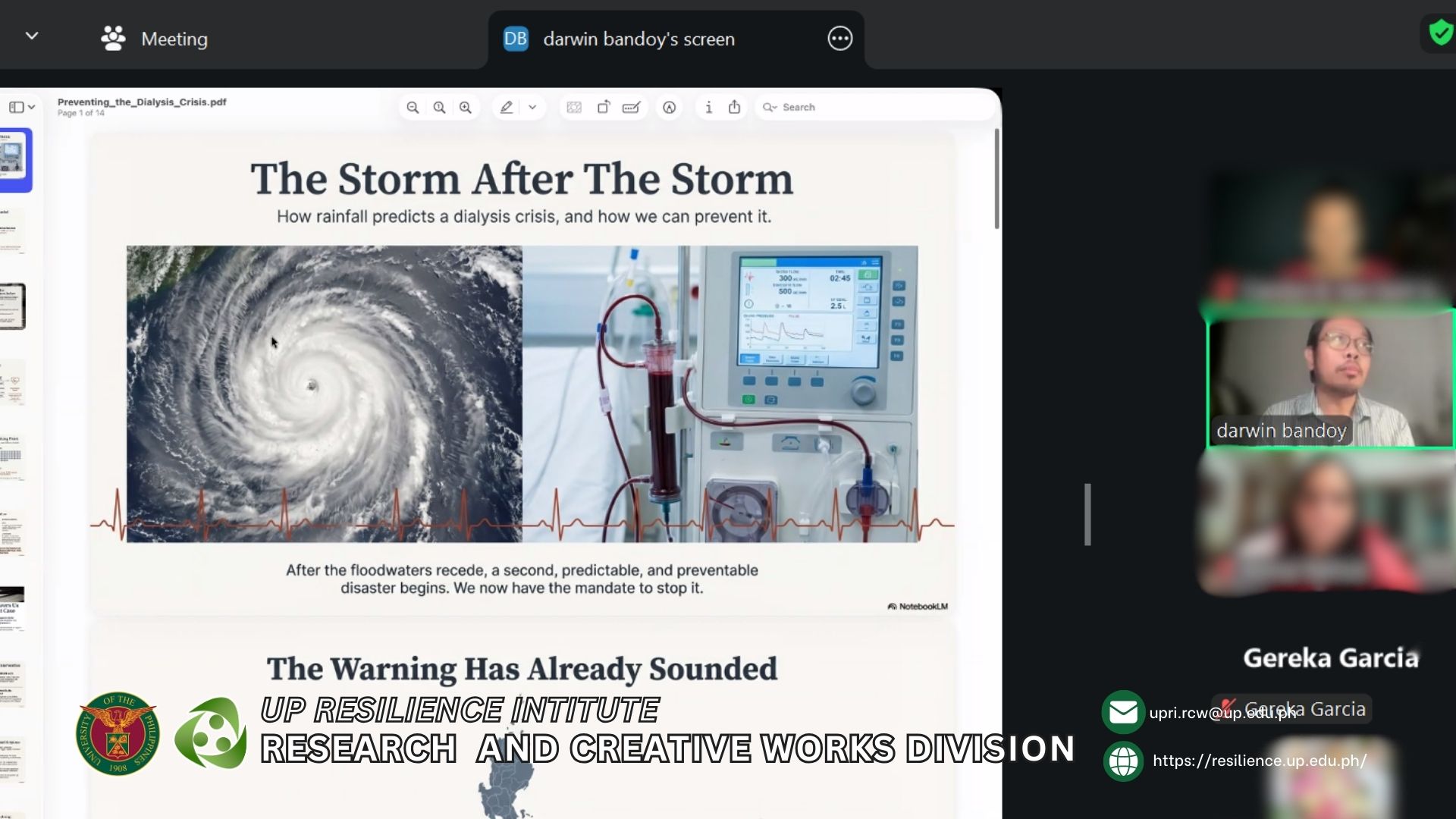
The meeting opened with Dr. DJ Darwin Bandoy, UPRI-RCW director, presenting the newly developed Policy Statement on Anticipatory Action for Leptospirosis. He highlighted that recent extreme rainfall events in Cebu and Catanduanes, exceeding 180 to 200 millimeters in 24 hours, mirror conditions that have historically led to severe leptospirosis outbreaks. The policy highlights how rainfall thresholds serve as vital early-warning triggers, enabling local governments to launch life-saving interventions before a single case emerges. With over half of severe leptospirosis patients developing kidney complications, these anticipatory measures can avert catastrophic strain on health systems, especially in areas with limited dialysis capacity.
Dr. Bandoy further detailed several anticipatory action measures. These include distributing prophylaxis, readying dialysis units for potential spikes in acute kidney injury, and intensifying surveillance. Other actions involve pre-positioning consumables, securing backup power for dialysis centers, mapping referral networks, and enforcing daily reporting requirements under RA 11332. Together, these steps directly link climate data to life-saving health interventions.
Delphi Findings
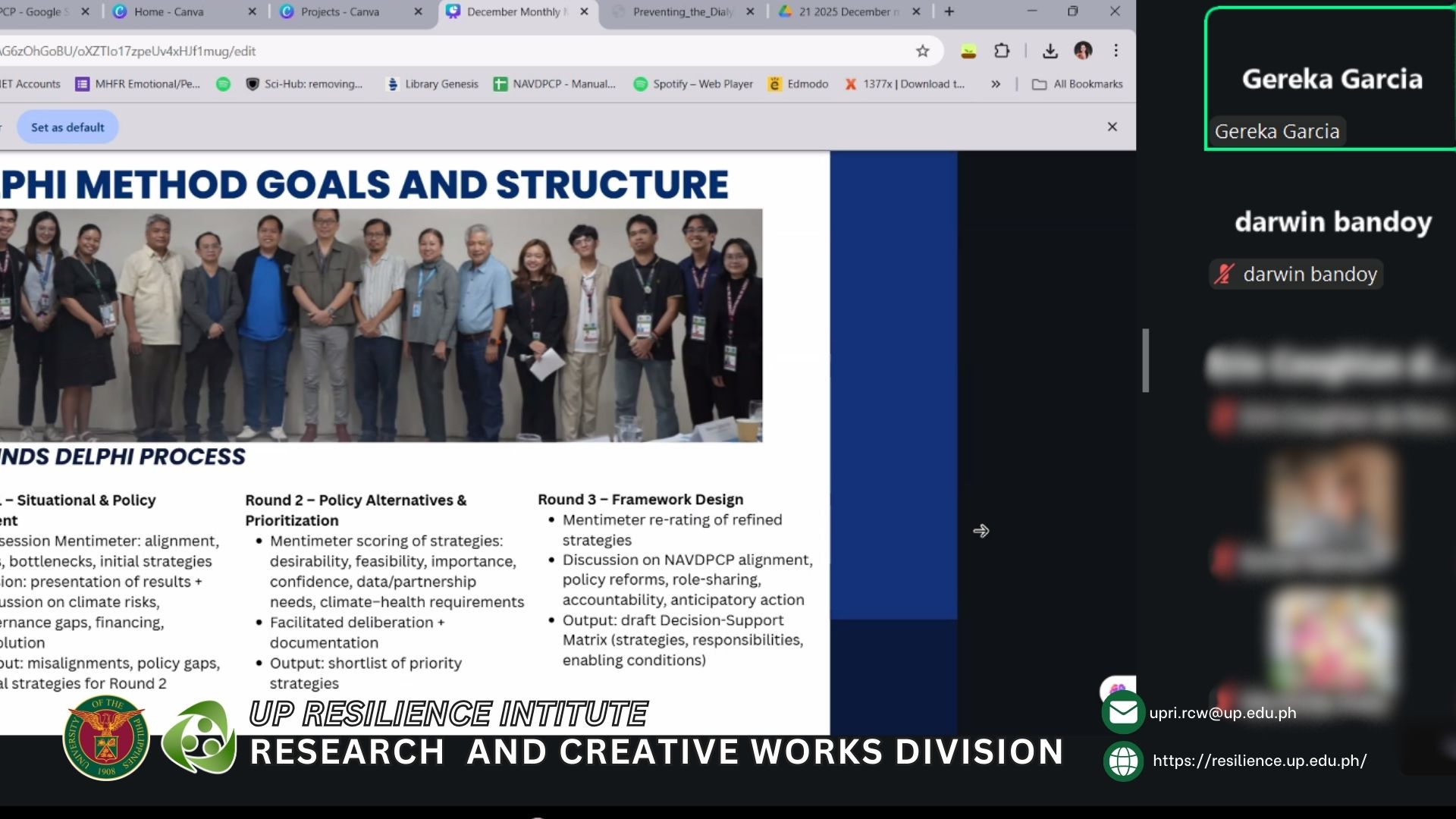
UPRI-RCW Junior Project Assistant Gereka Marie N. Garcia presented the Deliberative Policy Delphi Forum on Dengue Prevention and Control, which brought together experts in public health, disaster risk reduction, epidemiology, and governance to evaluate national dengue policies amid increasing climate variability. The forum applied the Delphi Method, a structured, iterative approach that uses questionnaires and controlled feedback to generate independent expert judgments.
Round 1 identified gaps in the National Aedes-Borne Viral Diseases Prevention and Control Program (NAVDPCP), including fragmented surveillance, limited barangay capacity, and underutilized climate indicators such as rainfall and temperature thresholds. Round 2 prioritized strategies like predictive modeling, climate-informed early warning systems, strengthened national-to-local data integration, and continuous risk communication. Round 3 produced a decision-support framework clarifying institutional roles, accountability, and integration of anticipatory action, aligning DOH, LGUs, PAGASA, academic institutions, and communities toward a shared climate-informed system for outbreak prevention. From these discussions, the team drafted two policy papers: Transmission Susceptibility among School-Aged Children: Policy Recommendations for Anticipatory Action in Public Schools and Policy Note on Anticipatory Action for Dengue Outbreak Prevention.
Strengthening Global and Local Capacities Through CORD
By presenting its leptospirosis policy note and Delphi findings to partner countries, the UPRI-RCW team advanced CORD’s broader mission of developing cross-disciplinary and cross-cultural expertise in anticipatory climate–health action. The exchange allowed partners working on maternal health in Bangladesh, refugee health in Uganda, drought-related nutrition challenges in Namibia and Lesotho, and cholera governance in Mozambique to compare methods, share analytical tools, and strengthen peer-to-peer capacity. The meeting reaffirmed the UPRI’s growing role as a regional leader in climate-informed health governance. With intensifying rainfall, flooding, and disease risks, the presentations emphasized that anticipatory governance, grounded in science, data integration, and community-engaged processes, must become central to national health systems.