
by Aira Joy C. Delos Angeles and Dr. Dj Darwin Bandoy
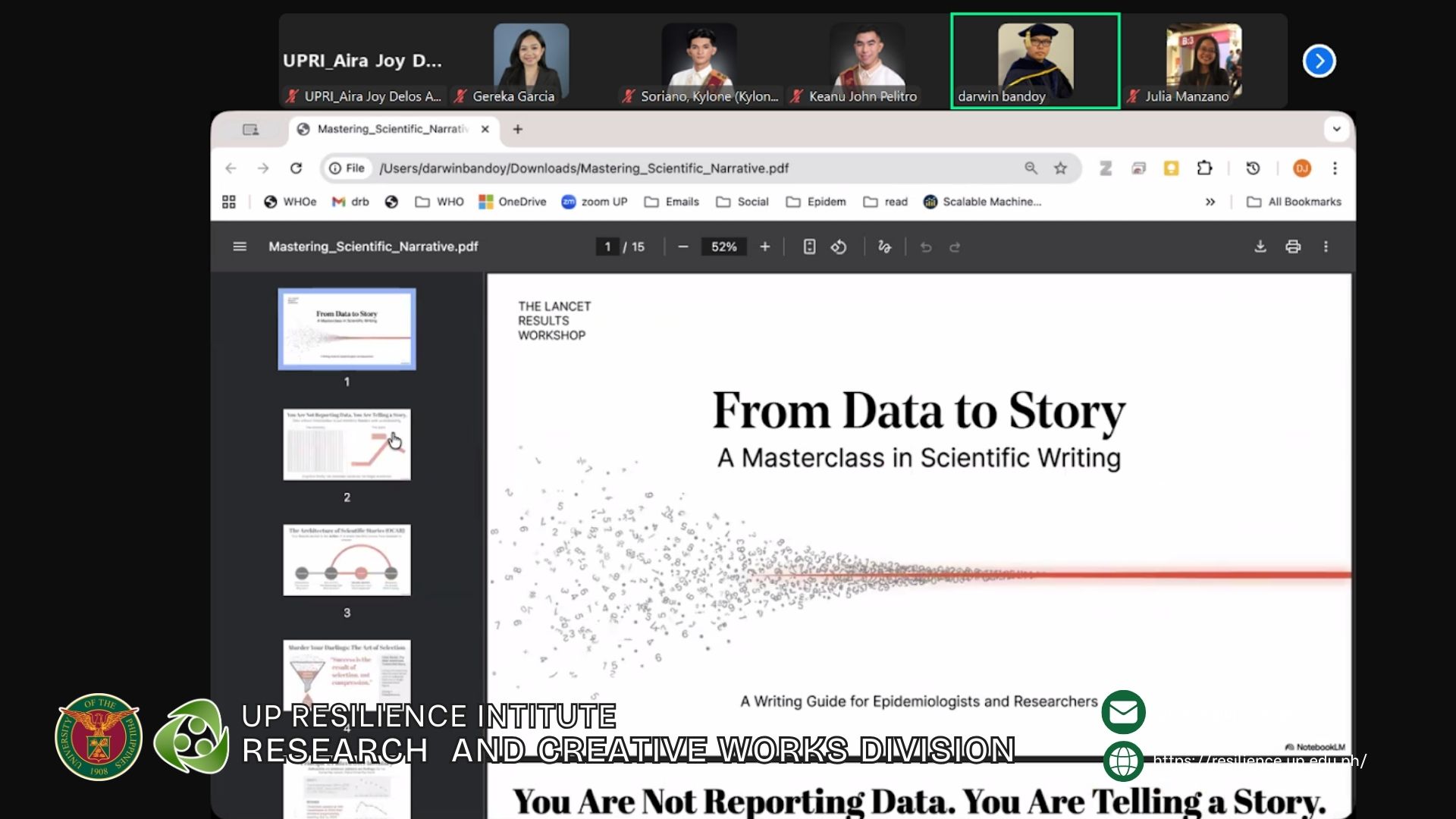
January 20, 2026 — Dr. Dj Darwin Bandoy, Director of the University of the Philippines Resilience Institute–Research and Creative Work (UPRI-RCW), led a strategic writing workshop aimed at strengthening the team’s ability to communicate research data clearly and effectively. Using the RCW Team’s ongoing dengue study as a working case, the workshop focused on turning technical results into meaningful narratives that can influence policy and decision-making.
The online workshop centered on improving research writing by shifting away from data-heavy descriptions toward clearer, finding-driven narratives. Emphasis was placed on presenting results in ways that highlight meaning, relevance, and real-world implications, particularly for policy and decision-making contexts.
Key Writing Principles Highlighted
During the workshop, Dr. Bandoy introduced the following principles to guide RCW research writing:
- Principle 1: Pattern over Inventory
Data points are evidence; patterns are findings. Rather than transcribing values, writers should characterize trends. - Principle 2: Magnitude over Significance
Statistical significance shows existence, while effect size demonstrates importance. - Principle 3: Anchor to Operational Meaning
Numbers require context. Statistical results should be linked to real-world consequences. - Principle 4: Name the Mechanism
When data reveal the “why,” the mechanism should be clearly stated, distinguishing analytical explanation from speculation. - Principle 5: Lead with Findings
Results function as arguments. Key findings should not be buried behind methodological details. - Principle 6: One Sentence, One Finding
Clarity is strengthened by concise statements that make findings quotable and distinct. - Principle 7: The Lead–Development Paragraph
Paragraphs should follow a news-style structure: a lead sentence stating the conclusion, followed by supporting evidence.
The research writing workshop forms part of UPRI-RCW’s outputs under the Center for Climate and Health glObal Research on Disasters (CORD) Project, a collaborative initiative of universities from climate-vulnerable regions in Africa and Asia, coordinated by Tufts University in the United States. The CORD Project supports research and case studies that strengthen anticipatory action before disasters, with a focus on protecting health and advancing health equity in climate-affected communities.
Through this initiative, the RCW Team aims to enhance both the quality of its research outputs and its capacity to translate scientific findings into actionable insights for disaster risk reduction and public health resilience.