
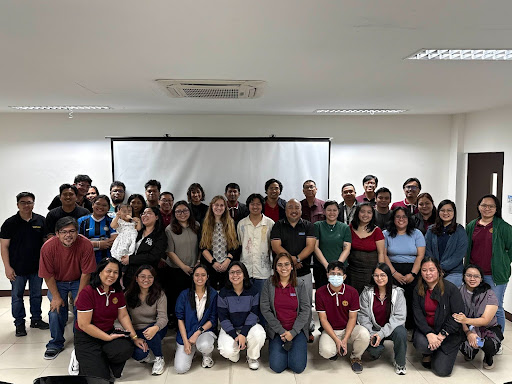
As climate change accelerates coastal risks across the Asia Pacific, the challenge facing coastal communities is no longer simply about protection but about making the right choices. In a Brown Bag Session hosted by the UP Resilience Institute (UP RI) last January 29, 2026, Annika Burkhardt, PhD candidate at the University of Sydney, shared ongoing research that examines how different types of coastal infrastructure shape long-term climate change adaptation outcomes.
The session compared grey, green, and hybrid coastal infrastructure projects across the region, highlighting critical insights. Coastal adaptation is not just an engineering problem. It is equally shaped by ecological conditions, community dynamics, leadership, governance, and the timing of decisions. Across the cases discussed, resilience emerged not from structures alone, but from how those structures are planned, implemented, and sustained over time.
Rethinking Traditional Coastal Protection
For decades, grey infrastructure such as seawalls, breakwaters, and dikes has been the default response to coastal hazards. These structures often provide visible and immediate protection, particularly in urban and high-value coastal areas. Yet the discussion underscored that this sense of security can come with trade-offs. Over time, grey solutions may constrain natural coastal processes, require costly maintenance, and struggle to adapt to accelerating climate change.
In response, there has been growing interest in green and hybrid approaches. Green infrastructure relies on nature-based solutions such as mangroves, dunes, reefs, and wetlands, while hybrid projects combine engineered structures with natural systems. These approaches can offer additional benefits, including ecosystem restoration, livelihood support, and adaptive capacity. However, they are not automatically successful. Their effectiveness depends on local environmental conditions, governance arrangements, and long-term commitment.
The presentation emphasized that no single infrastructure type is inherently superior. Instead, outcomes depend on how projects are designed, implemented, and governed within their specific local contexts.

Measuring What Works and What Does Not
The research addressed a key gap in coastal adaptation practice: the lack of a consistent, comprehensive evaluation of infrastructure outcomes. Reviewing over 250 Asia Pacific projects, the study mapped assessments across four dimensions—technical performance and durability, ecological impacts on ecosystems and services, social effects on communities, livelihoods, and cultural values, and economic considerations including costs, benefits, and long-term value.
The findings reveal a strong bias toward technical indicators, particularly for grey infrastructure. In contrast, social, ecological, and economic outcomes are often underexamined, especially for green and hybrid projects. This imbalance limits learning across projects and increases the risk of maladaptation, where interventions intended to reduce risk may instead create new vulnerabilities over time.
There Is No One-Size-Fits-All Solution
Using comparative analysis, the research examined how different conditions, such as infrastructure type, stakeholder engagement, leadership, project timing, and community livelihoods, interact to influence adaptation outcomes.
Rather than pointing to a single best solution, the analysis reinforces a central message. Effective coastal adaptation emerges from combinations of conditions, not from infrastructure type alone. Projects with strong leadership and meaningful stakeholder engagement were more likely to support long-term climate change adaptation, regardless of whether they relied on grey, green, or hybrid approaches.
Leadership, Stakeholders, and Windows of Opportunity
The latter part of the session focused on the role of leadership, stakeholder engagement, and timing, particularly the concept of windows of opportunity. While disasters often create urgency and open access to funding, these moments can also compress decision-making and reinforce reliance on rigid grey infrastructure.
In contrast, projects grounded in preparedness and long-term planning tend to allow for more inclusive processes and flexible designs. The research reframes windows of opportunity not as passive moments following disasters, but as conditions that can be deliberately shaped through governance, foresight, and institutional readiness.
Why This Matters for the Philippines
For the Philippines, where coastal communities, ecosystems, and livelihoods are deeply interconnected, these findings are especially relevant. With thousands of kilometers of coastline and a high dependence on coastal resources, infrastructure decisions have far-reaching social, economic, and environmental implications.
The session underscores the importance of moving beyond default, infrastructure-heavy responses and toward context-sensitive approaches that integrate engineering, ecosystems, and community needs. It also highlights the need to strengthen evaluation practices, leadership, and stakeholder engagement to avoid maladaptation and ensure that coastal investments genuinely reduce long-term risk.
As the Philippines continues to invest in coastal protection and climate resilience, the insights shared in this session offer a timely reminder. How decisions are made can matter just as much as what is built.