
Twelve years have passed since the unprecedented Typhoon Yolanda which heavily impacted Eastern Visayas. Going a step ahead of building back better, communities and schools should be informed of risks that compound the effects of disasters. UP Tacloban arranged a series of activities with the UP Resilience Institute and UP Diliman Department of Industrial Engineering and Operations Research to provide insights on disaster risk reduction and management last November 2025.
DRRM through Technology
Pagburubligay Kontra Kataragram: Eastern Visayas DRRM Summit was held last November 19, 2025 organized by UP Tacloban. It aimed to facilitate discussions on disaster risk reduction and management based on the experiences of local government units.
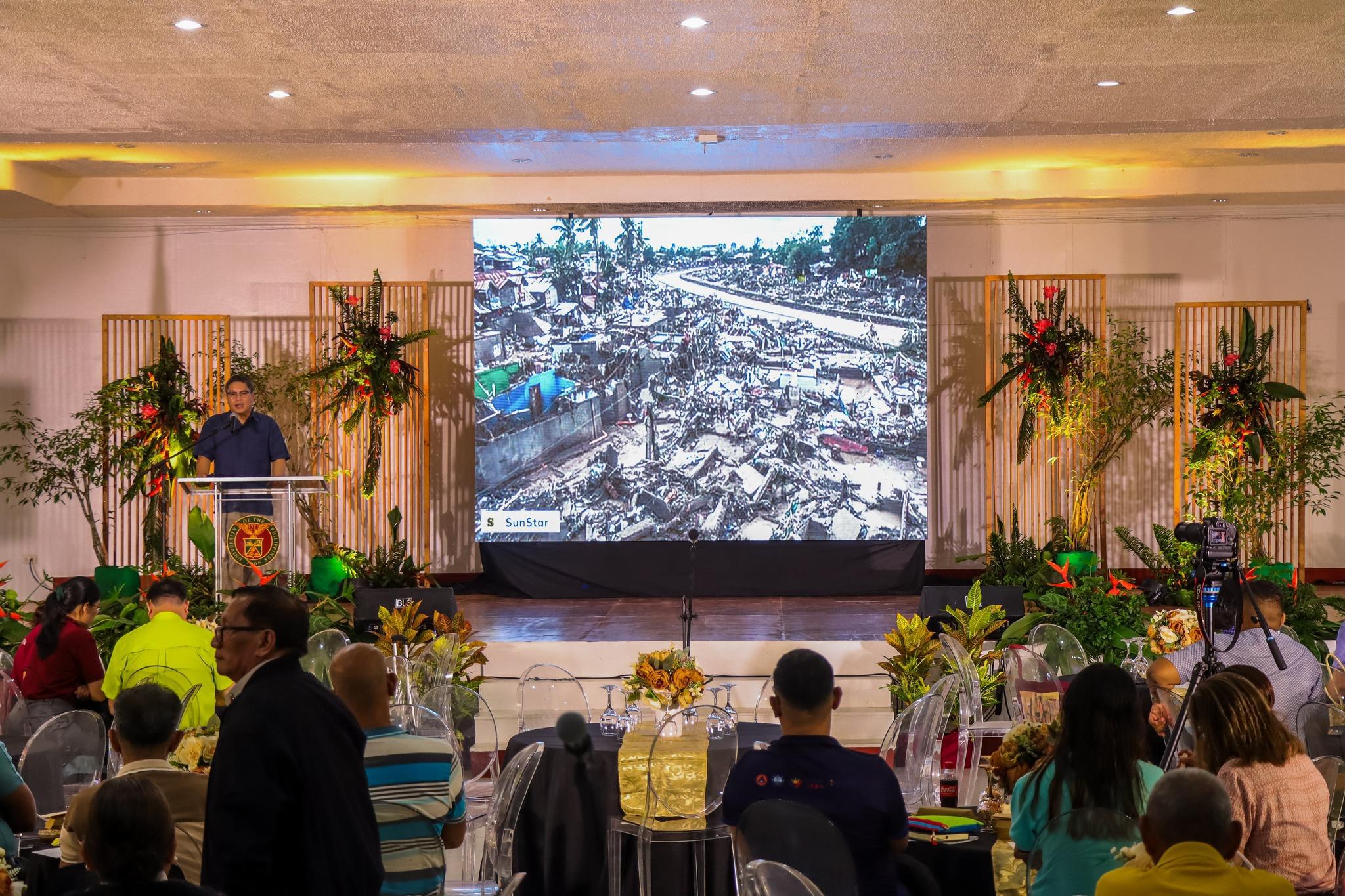
UPRI Executive Director Alfredo Mahar Francisco Lagmay provides an overview of the Eastern Visayas landscape
UPRI Executive Director Alfredo Mahar Francisco Lagmay shared his insights on the hazards in Eastern Visayas. These include severe weather conditions and susceptibility to earthquakes. He elaborated that interventions should be responsive to different hazards, such as landslides, tsunami, and liquefaction. Science-based planning and strategic foresight can save lives.

Asst. Prof. Raymond Freth A. Lagria shared Project ABRRAM
Asst. Prof. Raymond Freth A. Lagria, chairperson of the UP Diliman Department of Industrial Engineering and Operations Research, also presented Project ABRRAM (Adaptive Basic Resource Recognition and Allocation Model). The project aims to rapidly map critical facilities, alternative basic resources and terrain such as farms and inland water as well as hazard impacts. Currently, the project is developing systems using offline-based communication, deep learning, optimization and data science. Developing AI in service of the people can mitigate the cost of disasters.
DRRM Officers from various Eastern Visayas LGUs then shared their best practices and challenges faced in the recent years. Abuyog DRRMO shared about their recovery from the damages of Tropical Storm Agaton (Megi) in 2022 and the shift of their focus to family and Barangay-level preparedness planning (e.g. Family Preparedness Plan, Barangay DRRM Plan, Barangay Development Plan + and Climate and Disaster Risk Assessment). La Paz DRRMO emphasized how their previous training with NOAH for Comprehensive Land Use Planning (CLUP) and CDRA has increased the capacity of their unit’s mappers and have since been instrumental in their planning and response during hazard events. Borongan City DRRMO discussed how they have maximized the People Survival Fund for a flood control project that used bamboo to protect future livelihood. They also highlighted the benefit that their anticipatory actions to support agriculture (e.g. cold storage facility) as well as their barangay-level trainings for Rapid Damage and Needs Assessment and Incident Command System. Ormoc City DRRMO recalled how they were overwhelmed with calls for rescue during Typhoon Opong (Bualoi) and have since implemented pre-emptive evacuation. This has minimized calls for rescue during Typhoon Tino (Kalmaegi). They have also prioritized the regular clearing of waterways and procurement of their own warning system.
DRRM through Art and Play
The UP Resilience Institute, in collaboration with UP Tacloban and Ugnayan ng Pahinungod, and support of Project ABRRAM, conducted IRAYA: Initiating Resilience through Art and Youth Action the next day, November 20, 2025 in celebration of the National Children’s Month.
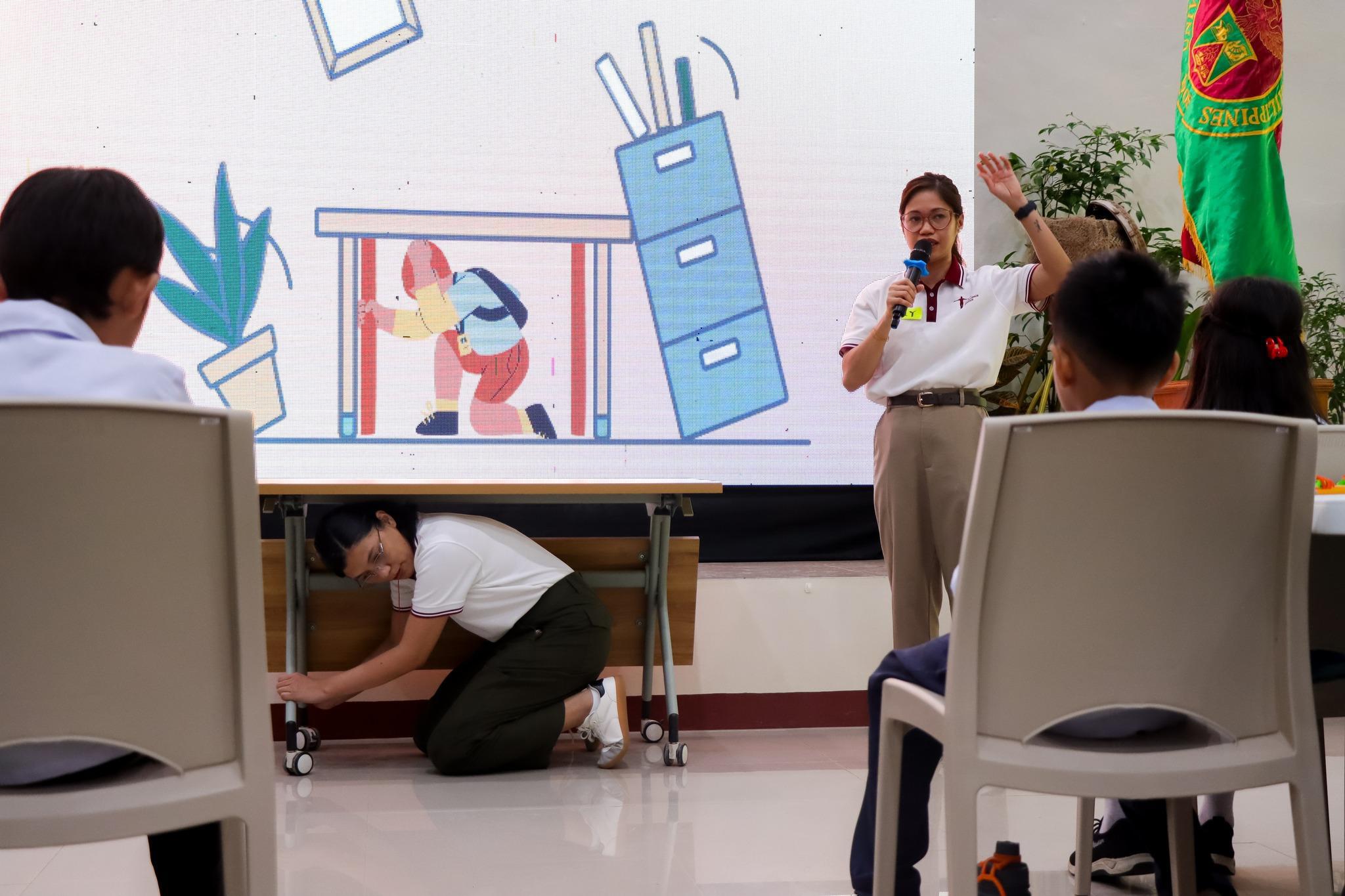
NOAH HAT and KS discussed earthquakes
Seventy-five Grade 4 students from public elementary schools joined the disaster preparedness workshop. Ms. Jolly Sulapas of the NOAH Hazard Assessment Team explained why and how earthquakes happen. She shared key concepts such as magnitude and intensity which was reinforced by a song on earthquakes written by Guro sa Sining ng Bayan. It was followed by a game called Go Bag Hunting. Children looked under their seats for Go Bag items, such as canned goods and a flashlight. Mr. Chris Sanchez of the Knowledge Sharing Division led the icebreaker while Mr. Sonny Ongkiko of the Institution Building Division unpacked the Go Bag for the children to see. Dr. Likha Minimo engaged children to understand tsunamis through storytelling. Julius Macadine of the YouthMappers led the activity on mental mapping where children illustrated a map of their route from their homes to the evacuation center. Dr. Minimo then discussed tropical cyclones and storm surge. She also presented a video clip of Typhoon Yolanda, the unprecedented super typhoon that devastated the region, to help them visualize what happened in 2013.
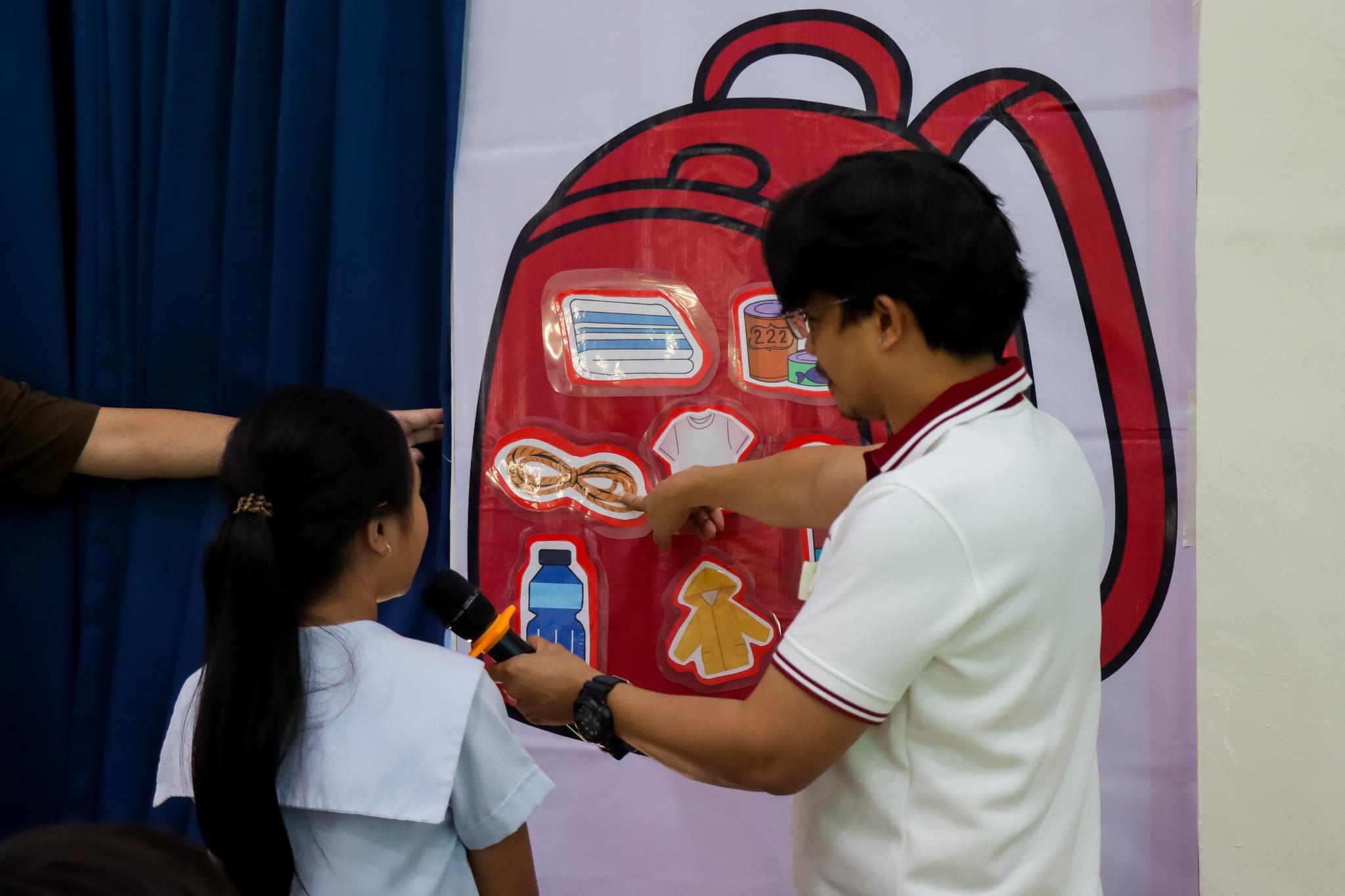
Games were conducted to engage children in discussions
By the end of the workshop, Ms. Kel Almazan facilitated ‘Paglaum 2050,’ which translates to ‘hope’ in Waray. Children wrote their dreams for themselves and their communities on cut-out leaves. One student answered, “Balang araw, sana mayroong malaking building para sa pag-tsunami at pag-bagyo.” The activity concluded by sharing learnings and key takeaways. Anne of San Jose Elementary School shared, “Ang natutunan ko sa araw na ito ay ang duck, cover, hold at huwag hintayin na pupunta ang tsunami at pumunta ka ng maaga sa malayong lugar at hindi ka maabutan ng tsunami.”
IRAYA aims to address the gaps in disaster preparedness education and climate literacy through art and play. It will continue to seek partnerships to raise awareness and embed a culture of preparedness and ecological consciousness.
Twelve years have passed and Eastern Visayas remains at the frontline of climate and geological hazards. But equipped with skills and information, they can lead examples of anticipatory action and preparedness.