
Tourist spots may be vulnerable to hazards and prone to disasters if not planned accordingly. To learn more about the topic, the UP Asian Institute of Tourism (AIT) with Asst. Prof. Monina Buccat visited the UP Resilience Institute and NOAH Center last March 3, 2025 under their class of ‘Risk, Resilience, and Sustainability in Tourism.’
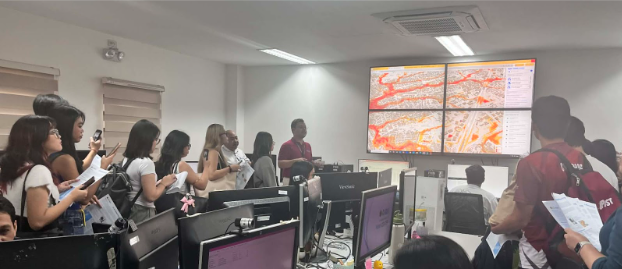
AIT students toured around the NOAH Center
Director of the Knowledge Sharing Division, Dr. Likha Minimo, began the discussion with an overview of the relationship between tourism and resilience. She cited a quote by Badillo and Astilla in 1978, after their assessment of the Moro Gulf earthquake and tsunami disaster, “What is now barren, will be densely populated. Empty beaches will be filled with residences, tourist facilities, factories, powerplants, etc. Offshore, there will be not merely seaweed and oyster farms and fish corral but also storage facilities, tank farms and the like.” She then highlighted the importance of the tourism industry not only in disaster preparedness but in the development planning of local government units. Chief Science Research Specialist of the Education Division Rich Ybanez provided an overview of the UP Resilience Institute.
The Flood Modelling Component shared their knowledge on modelling and assessments which are translated into recommendations and action planning. The Hazard Assessment Team then identified different hazards, from a storm surge to land subsidence. For Planning, they shared the importance of the land use plan to guide future actions of a community in terms of utilization, acquisition, and disposition of land. The WebGIS component also had a demonstration of the NOAH and GINA Applications.
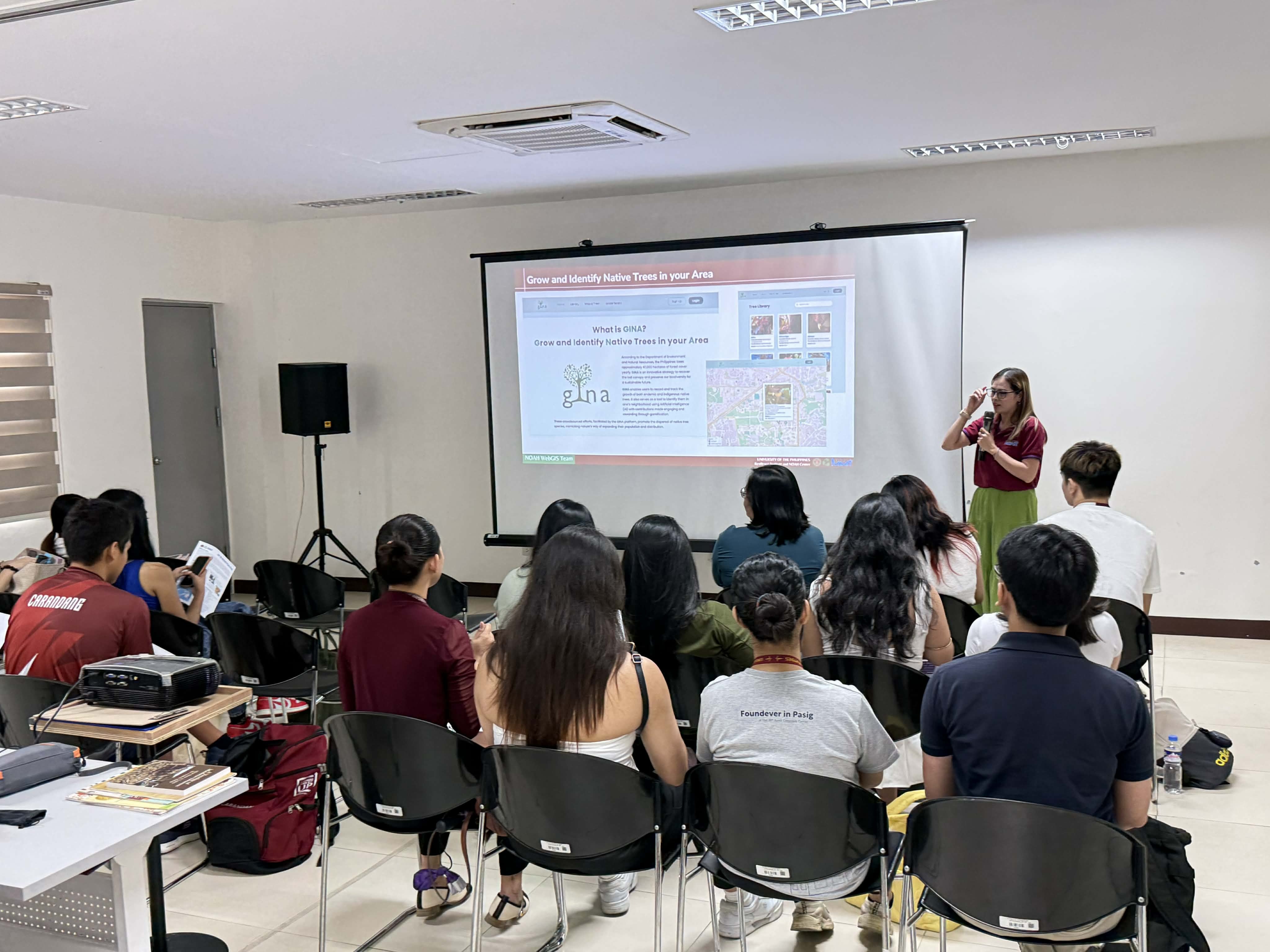
WebGIS presented the GINA Application
It was followed by presentations from different divisions. The Education Division shared their regular programs and introduced the Master of Climate and Disaster Resilience, a new graduate program at UPOU. The Knowledge Sharing Division presented their activities to reach partners and communities. The Research and Creative Work Division presented their new game which is under development. The Institution Building then explained their initiatives which include strengthening the resilience of campuses and development of the Public Service Continuity Plan, among others. They also began iTALA or the ‘Integrated Tally and Accounting for Lives in Adversity’ as a low-cost, replicable, accessible, customizable and localizable communication channel for the incident command system. Their visit ended with a tour around the office.
Tourism should also be risk-informed to anticipate changes in weather and climate. Through these visits, students gain understanding on the link of disasters and climate change across different fields.