
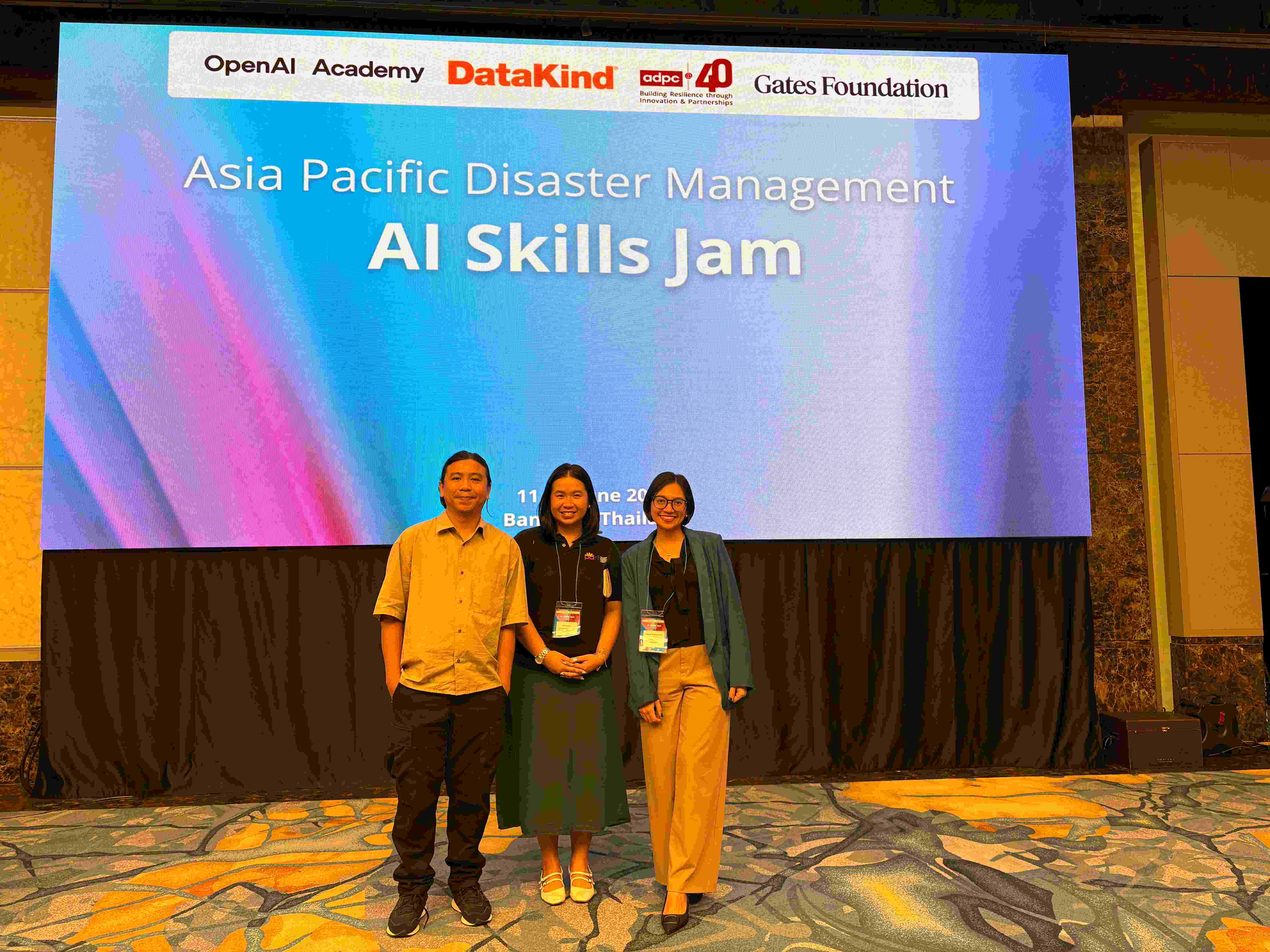
On June 11-12, 2026, the University of the Philippines Resilience Institute (UPRI) participated in Phase 2 of the AI Skills Jam for Disaster Management Professionals in Bangkok, Thailand. Convened by the OpenAI Academy, DataKind, the Asian Disaster Preparedness Center (ADPC), and the Gates Foundation, the two-day event built upon the foundational concepts established in Phase 1, shifting the focus toward rapid execution and technical prototyping.
Representing UPRI and the NOAH WebGIS team, Feye Andal joined disaster risk reduction (DRR) specialists and software builders from across the Asia-Pacific region to explore how agentic AI can be integrated directly into core disaster management systems.
From Concept to Code: The “Build” Track
While Phase 1 focused on identifying operational opportunities and structuring workflows, Phase 2 challenged participants to move rapidly from abstract ideas to functional tools.
Participants selected between two main pathways: a Learn track—focused on deepening practical fluency with tools like ChatGPT and Codex—and a Build track, designed for intensive technical collaboration.
Opting for the Build track, UPRI joined a fast-paced development environment where domain experts were paired directly with technical AI Builders. The objective was to translate actual institutional challenges into working prototypes within a 48-hour window.
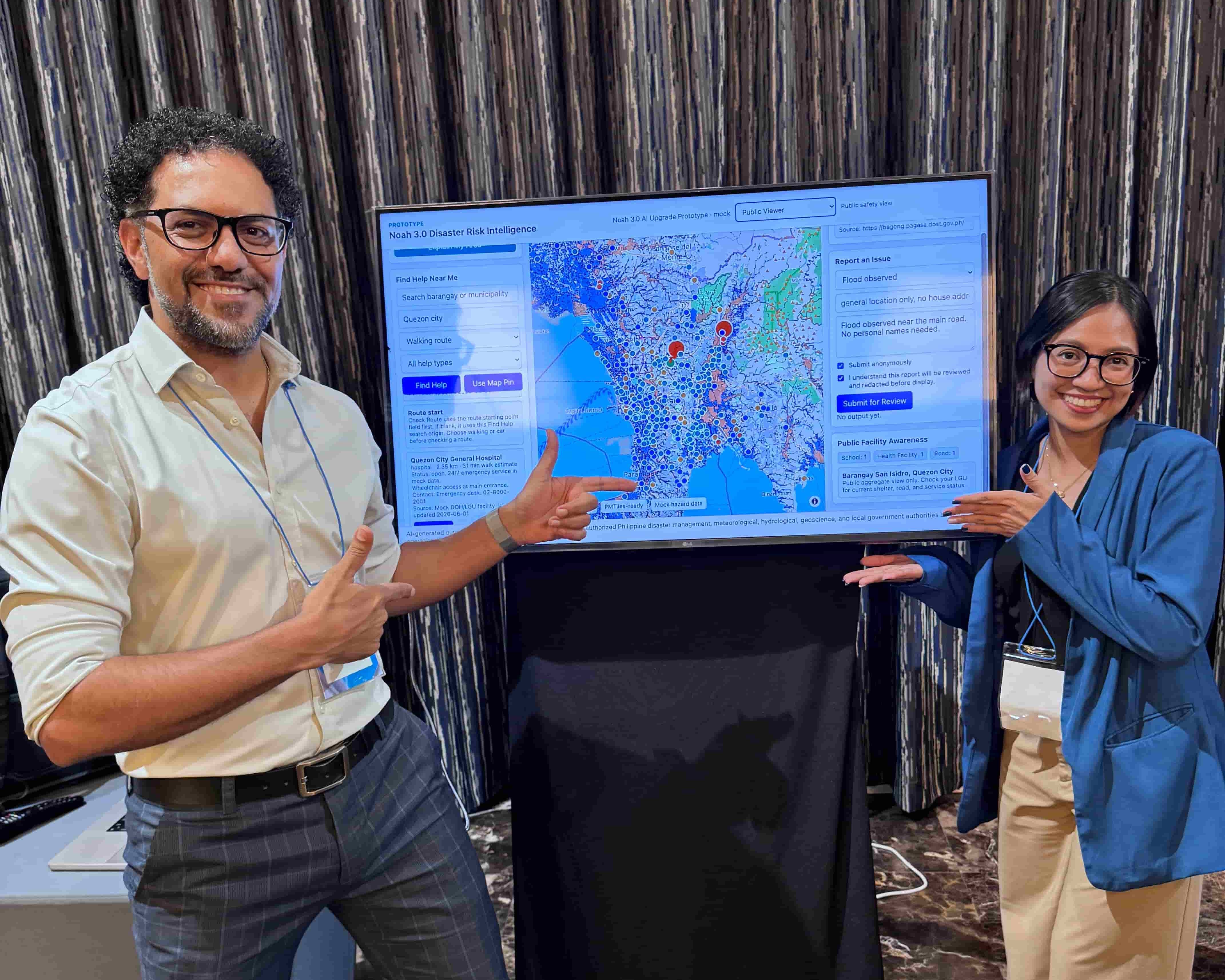
Prototyping NOAH 3.0
Working alongside AI Builder Emad Karim, the UPRI team focused on conceptualizing and building an AI-enabled evolution of the Institute’s flagship platform: NOAH 3.0. The joint effort aimed to address key challenges in translating complex spatial hazard data and risk analytics into actionable, conversational insights for a diverse range of stakeholders.
Rather than delivering a generic interface, the experimental prototype was designed to adapt directly to specific end-user roles—tailoring outputs for the general public, local government units (LGUs), and humanitarian responders. Core features engineered during the jam included:
- Role-Based Views: A user-type selector allowing the platform to adjust its reporting complexity and recommended actions based on the user’s operational needs.
- Proximity & Evacuation Assistance: A “Find Help Near Me” tool that dynamically identifies the closest critical facilities, coupled with localized recommendations for safe evacuation routes based on spatial data.
- Conversational Safety Queries: An interactive “Ask About Safety” query engine that translates raw hazard layers—such as flood and landslide maps—into clear, plain-language summaries answering the crucial question: “What does this risk mean for you?”
- Community Safety Dashboards: Centralized hubs aggregating sample NOAH hazard layers, real-time alerts, and official advisories to support situational awareness.
- Participatory Reporting: Crowdsourced reporting tools enabling users to submit real-time updates, such as local flood observations, directly back into the platform to enhance situational maps.
By combining UPRI’s deep domain knowledge in geospatial analysis and web mapping with agile AI development techniques, the team successfully engineered a functional, interactive prototype that demonstrates how conversational AI can simplify decision-making before and during disasters.
The exercise demonstrated how large language models and modern development frameworks can be integrated with complex spatial databases to accelerate data synthesis, streamline query handling, and make disaster-related information more accessible during crises.
Demonstrating Potential: Feedback and Peer Review
Following the rapid prototyping phase, participants had the opportunity to exhibit their working models to fellow builders, disaster risk practitioners, and participating organizations. During the demonstration session, Miss Andal and Builder Mr. Karim presented the experimental NOAH 3.0 interface, showcasing how AI could interface with spatial datasets to streamline emergency workflows.
The prototype received positive feedback from attending international partners. Notably, representatives from organizations such as the United Nations Office for Disaster Risk Reduction (UNDRR) commended the tool’s practical orientation, noting that intuitive, AI-supported data interfaces are highly valuable for enhancing real-time decision-making during disaster operations.
Key Insights: Domain Expertise as the Anchor
The primary takeaway from Phase 2 was the transformative effect of direct, interdisciplinary collaboration. The workshop demonstrated that the most effective application of AI occurs when deep domain knowledge is directly paired with technical builders in an environment structured for rapid iteration and hands-on experimentation.
Key insights for institutional AI integration include:
- Accelerated Innovation Cycles: Development timelines for early-stage software features can be reduced from months to days by integrating generative and agentic AI tools into the prototyping process.
- Co-Creation Over Adoption: Disaster management agencies must act as co-creators of AI systems, ensuring that algorithms are calibrated to real-world operational constraints rather than relying on off-the-shelf assumptions.
- Enhanced Capability, Not Replacement: Machine learning models rapidly process and structure vast datasets, enabling human experts to make more informed decisions under high-pressure conditions.
Looking Ahead
Phase 2 of the AI Skills Jam underscored that AI is no longer just a subject of exploration, but an operational accelerator, especially when used with deep care. For UPRI, the development of the NOAH 3.0 prototype represents a meaningful step toward modernizing national disaster risk management tools. As climate hazards become increasingly complex, UPRI remains committed to leveraging emerging technology, open data, and geospatial science to build resilient, better-prepared communities across the Philippines.