
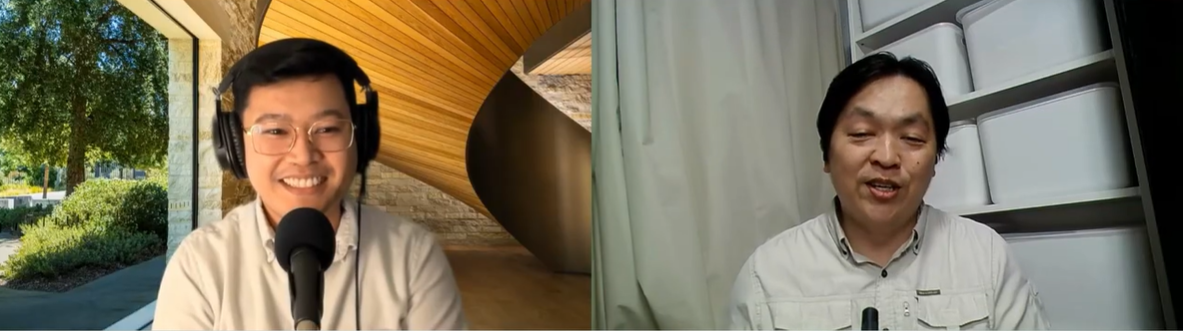
As various institutions in the Philippines continue to mitigate the devastating effects of annually occurring typhoons, the need for more timely and cost-effective rainfall prediction models has become more urgent than ever. In the 101st episode of the Behind the Science Podcast Series, meteorologist Dr. Gerry Bagtasa shared his team’s study on the potential of Artificial Intelligence (AI)-based tropical cyclone rainfall forecasting, which aims to better understand the spatial distribution and intensity of rainfall associated with tropical cyclones.
Current tropical cyclone forecasting practices by weather agencies in the Philippines, such as PAGASA, primarily focus on wind speed. While these efforts help determine the path and categorization of approaching storms, they often overlook the complexity of rainfall forecasting. Yet understanding rainfall intensity and distribution is just as important in identifying which areas may be exposed or vulnerable to the impacts of typhoons. In the Philippine context, rainfall is the main driver of flooding and landslides. Thus, in their study, Dr. Bagtasa emphasized the need to better understand and predict cyclone-related rainfall patterns and intensity. Exploring the use of AI in weather forecasting is therefore seen as a promising approach for predicting rainfall more quickly and efficiently.
Using data from past typhoons between 1951 and 2015, Dr. Bagtasa’s study explored AI models like Self-Organizing Maps (SOM) and Random Forest to predict rainfall from tropical cyclones. The former first groups typhoons with similar paths and affected regions so the model can account for local rainfall patterns, while the latter then uses past data from that group to estimate how much rain the new typhoon might bring and where. According to Dr. Bagtasa, these AI models showed impressive results, performing just as well as traditional models that rely on complex physics equations and heavy computational processing.
Beyond the technical discussion, the podcast episode also highlighted Dr. Bagtasa’s academic and professional journey. His growing passion for Physics, the field he specialized in from college through his doctoral studies, stemmed from the fact that it came naturally to him. Rather than relying on rote memorization, he was drawn toward Physics because it requires a deeper understanding of complex equations and analytical thinking of natural phenomena. As a researcher, he emphasized the importance of persistence amid challenges such as securing funding, undergoing peer review, and achieving publication acceptance, noting that these are integral parts of the learning and research process.
Flooding and landslides are prevalent hazards associated with cyclone-induced rainfall and are frequently experienced in our country. Given this, the potential of AI as a transformative tool that can make various fields of academic pursuit more efficient and accessible should be maximized. However, human judgment from meteorological experts remains essential, Dr. Bagtasa noted. AI should be viewed as a supplement to, rather than a replacement for, expert decision-making.
Youtube: bit.ly/btspodcast-yt
Spotify: bit.ly/btspodcast-spotify
Facebook: https://bit.ly/btspodcast-fb
Research spotlight:
Mesias CG, Bagtasa G. 2025. AI‐Based Tropical Cyclone Rainfall Forecasting in the Philippines Using Machine Learning. Meteorological Applications. 32(4). https://doi.org/10.1002/met.70083
Do you want to nominate a scientist in the field of DRR and geosciences to be featured on the Behind the Science Podcast? Or, have you read an author’s publication whose behind-the-scenes story you are eager to hear about? Email us at upri.educ@up.edu.ph, and we will do our best to feature them on the BTS Podcast!