
From Classroom to Context: Launching the Fieldwork
The University of the Philippines Resilience Institute (UP RI) welcomed undergraduate engineering students from the University of Sydney on 12 January 2026 as part of the Global Engineering Fieldwork subject. The visit marked the start of their 28-day field engagement in Manila, Philippines, and forms part of a program supported by the Australian Government’s New Colombo Plan, which aims to strengthen linkages between Australia and the Indo-Pacific region.
nstitutes a full academic subject, requiring students to participate in a full working week and complete assessed outputs. The cohort is a competitively selected group of undergraduate engineering students awarded scholarships to participate in the program, with students drawn from civil and biomedical engineering backgrounds.
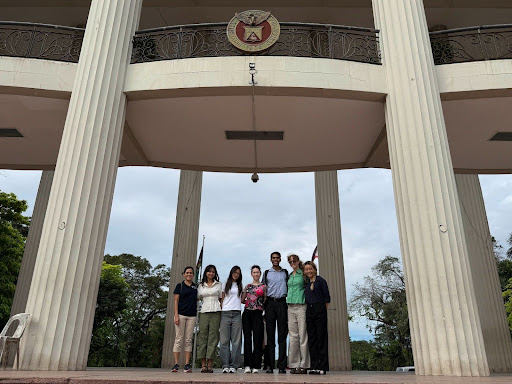
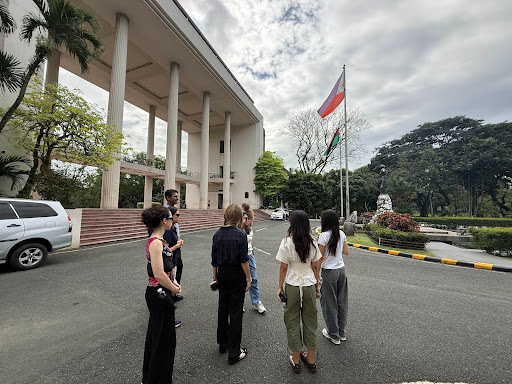
The welcome at UP RI began with a campus tour, hosted by the UP RI–NOAH Planning Component, which introduced the visiting students to the University of the Philippines Diliman campus. This was followed by a group lunch, which provided an informal opportunity for initial exchanges and relationship-building between the students and UP RI–NOAH staff. While three students were assigned to UP RI for their fieldwork, other students who were also part of the Global Engineering Fieldwork program but were assigned to UP National Center for Transportation Studies, also joined the tour.
Inside UP RI: Learning How Resilience Is Built
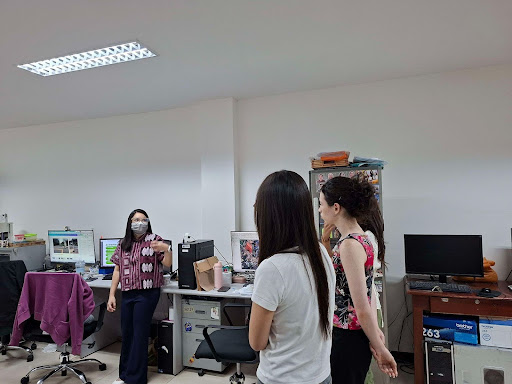
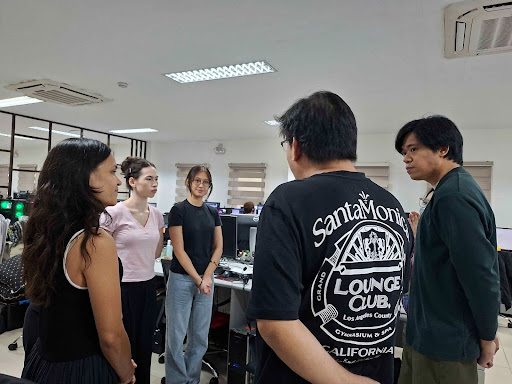
Following the campus tour, the students participated in an orientation and office tour at UP RI, where they were introduced to the institute’s organizational structure and its various divisions and components. The session highlighted how interdisciplinary research underpins UP RI’s approach to resilience building.
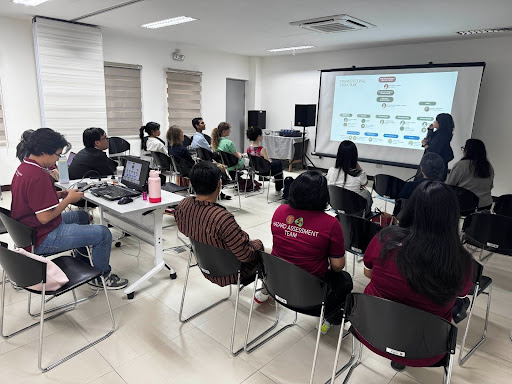
UP RI’s educational and researchtools such as the virtual reality sandbox, shake table, and 3D-printed models were also featured during the office tour. The visit concluded with an introduction to the formulation of drainage master plans led by the UP RI–NOAH Flood Modeling Component. This session situated the students’ fieldwork within a concrete urban resilience and infrastructure planning context, demonstrating how technical analysis, stakeholder engagement, and local governance intersect in large-scale flood management efforts.
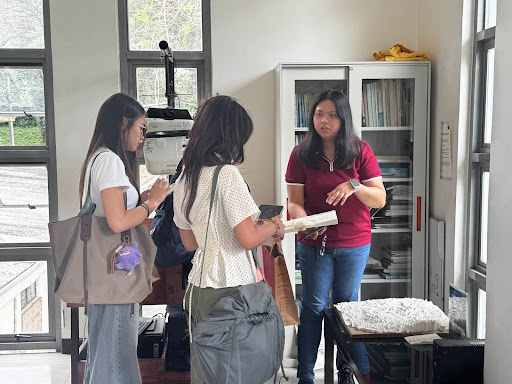
Participating in the fieldwork and assigned to UP RI are three University of Sydney students from diverse engineering backgrounds. Alexi Vicente, a Biomedical Engineering and Medical Science student, brought a strong interest in community-centered engineering shaped by her global experiences and personal values. Breena Woodbury, a third-year Biomedical Engineering and Medical Science student specialising in Nanoscale Biotechnology, expressed interest in an applied research perspective informed by her involvement with Engineers Without Borders. Katrina Pai, a third-year Civil Engineering student, added strengths in structural thinking, communication, and community engagement through her leadership roles.
As part of the Global Engineering Fieldwork, the students are expected to complete project briefs designed around clearly defined problem statements that respond directly to the needs and priorities of the partner organization. The scope of the project briefs is focused on the Metro Manila area, in line with the students’ in-country base and the limited duration of the program. The expected output of the engagement is a final report documenting the analyses, methodologies, and findings produced during the fieldwork, which will be submitted to the UP RI at the conclusion of the program.
Following their initial visit, the three students returned to the UP RI office on 13 January 2026 for a brief courtesy visit and discussion with UP RI Executive Director Mahar Lagmay, which also served as an opportunity to further discuss the general workplan for the duration of their stay.
Turning Analysis into Action: A Culminating Case Study
As the culmination of their field engagement with UP RI, the students presented a case study on urban flooding in Caloocan City, with a focused analysis of Barangay 170. The project assessed flood risk and evaluated mitigation strategies using a combination of hydraulic modeling, field observations, stakeholder engagement, and contextual research. Using FLO-2D and ArcMap, the students produced flood hazard and flood depth maps that identified high-risk zones, primary flow pathways, and areas of persistent inundation. Their analysis highlighted how flooding in Barangay 170 is shaped not only by local drainage constraints but also by interconnected upstream inflows, urban density, and system-wide saturation during prolonged rainfall events.
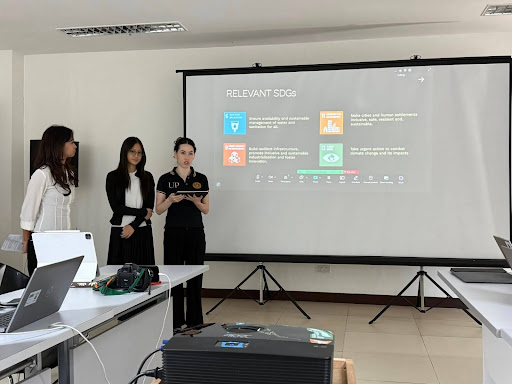
Building on these findings, the students developed a set of context-appropriate structural and non-structural solutions aimed at reducing flood risk while supporting long-term urban resilience. Proposed interventions included permeable pavements, bioswales, detention basins, rainwater harvesting systems, and hybrid “sponge city” approaches that integrate green and grey infrastructure. These options were evaluated using a decision matrix that considered space availability, effectiveness, cost, maintenance requirements, and sustainability, ensuring that recommendations were grounded in both technical feasibility and local urban conditions.
The presentation emphasized that effective flood mitigation in highly urbanized areas like Caloocan City requires integrated planning that combines engineering analysis, community-level action, and governance considerations. By situating their technical outputs within the realities of Metro Manila’s environmental, social, and institutional context, the students’ work demonstrated how applied engineering fieldwork can directly support local resilience planning efforts and contribute to evidence-based decision-making at the city and barangay levels.
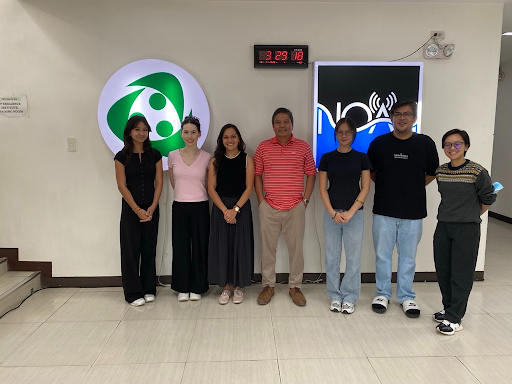
Overall, the visit to UP RI laid the foundation for collaborative learning and knowledge exchange, reinforcing the shared commitment of partner institutions to advancing resilient, inclusive, and socially responsive engineering practice.