
by: Gereka Marie N. Garcia, Julia Fye S. Manzano, and Dr. Dj Darwin Bandoy
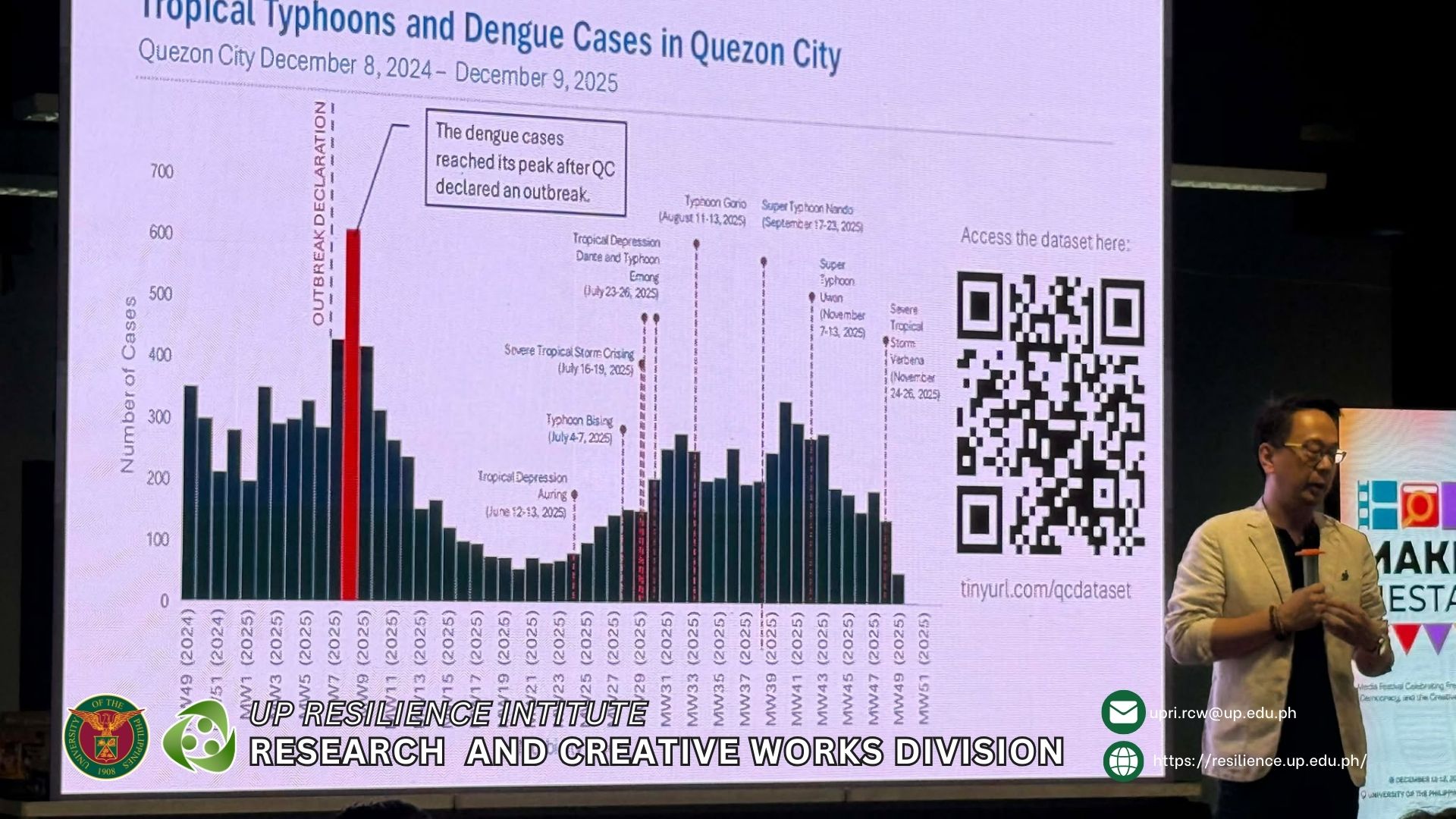
December 12, 2025 — Quezon City has made its weekly dengue surveillance data publicly accessible following discussions conducted under the Center for Climate and Health Global Research on Disasters (CORD) project by the UP Resilience Institute – Research and Creative Works (UPRI-RCW). This move marks a significant step toward transparent, data-driven public health governance and strengthens anticipatory action against dengue outbreaks linked to climate risks. Open access to surveillance data allows researchers, policymakers, media, and communities to monitor trends, support early warning efforts, and inform timely interventions.
The weekly dengue cases data was first presented during MAKI+Fiesta 2.0 on December 11, 2025, held at the University of the Philippines Diliman. The event gathered creators, changemakers, and media innovators convened by the Quezon City Government, the UP System, Probe Productions, FYT Media, and PumaPodcast.
Quezon City’s commitment to open data was earlier announced during the Deliberative Policy Delphi Forum on Dengue Prevention and Control on November 21, 2025. City Epidemiologist Dr. Rolly Cruz shared that the city is drafting to institutionalize open access to dengue data, stating, “What we are going to do in the next year is to make a draft to have our data in an open access so that we can expedite data sharing for researchers.” The initiative aims to shift from ad hoc data requests toward a standardized and timely data-sharing system that supports research and prevention.
The forum was organized by UPRI-RCW under the CORD Project and brought together experts in public health, epidemiology, disaster risk reduction, climate science, and governance. UPRI-RCW Director Dr. Darwin Bandoy emphasized the value of collaboration between researchers and local governments, saying, “Through CORD, we are able to co-produce knowledge with LGUs and ensure that scientific data translates directly into actionable public health strategies.” The discussions highlighted the importance of integrating scientific evidence into local policy and practice.
CORD is a seven-university consortium coordinated by Tufts University that addresses climate-sensitive health risks across Asia and Africa. In the Philippines, the project is implemented by UPRI-RCW and focuses on anticipatory approaches to dengue and other climate-related health hazards by integrating local surveillance data with predictive models. The public release of weekly dengue data in Quezon City is expected to strengthen research collaboration, improve evidence-based policymaking, and enhance protection for vulnerable communities.