
By: EnP. Marie Claire P. Mandar and Engr. Kristian Audri D. Gabriel
The University of the Philippines Resilience Institute (UP RI) – Nationwide Operational Assessment of Hazards (NOAH) Center Planning Component participated in the Climate-Smart and Resilient Infrastructure Roundtable Discussion organized by the Department of Economy, Planning, and Development (DEPDev) at the Asian Development Bank (ADB) Headquarters in Mandaluyong City held last October 21, 2026. Representing UP RI-NOAH Center were EnP. Marie Claire P. Mandar, Science Research Specialist II, and Engr. Kristian Audri D. Gabriel, Junior Project Officer.
The roundtable discussion brought together representatives from various government agencies, development partners, and other stakeholders to discuss the development of a national framework for infrastructure resilience and explore opportunities for collaboration. The ADB, the Japan International Cooperation Agency (JICA), the World Bank Group – International Finance Corporation (IFC). and the United Nations Children’s Fund (UNICEF) highlighted their initiatives and approaches aimed towards advancing climate-smart and disaster-resilient infrastructure.
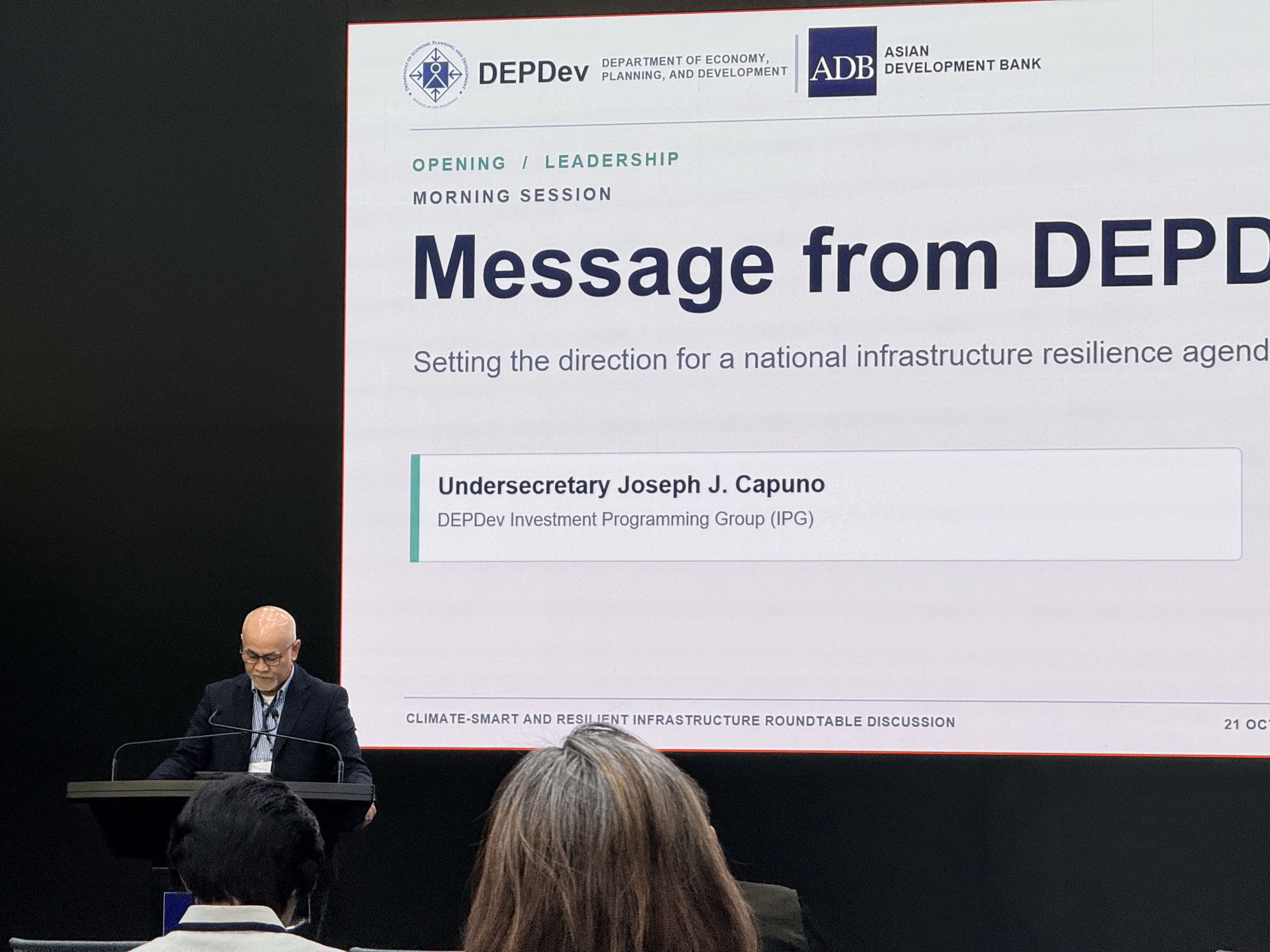
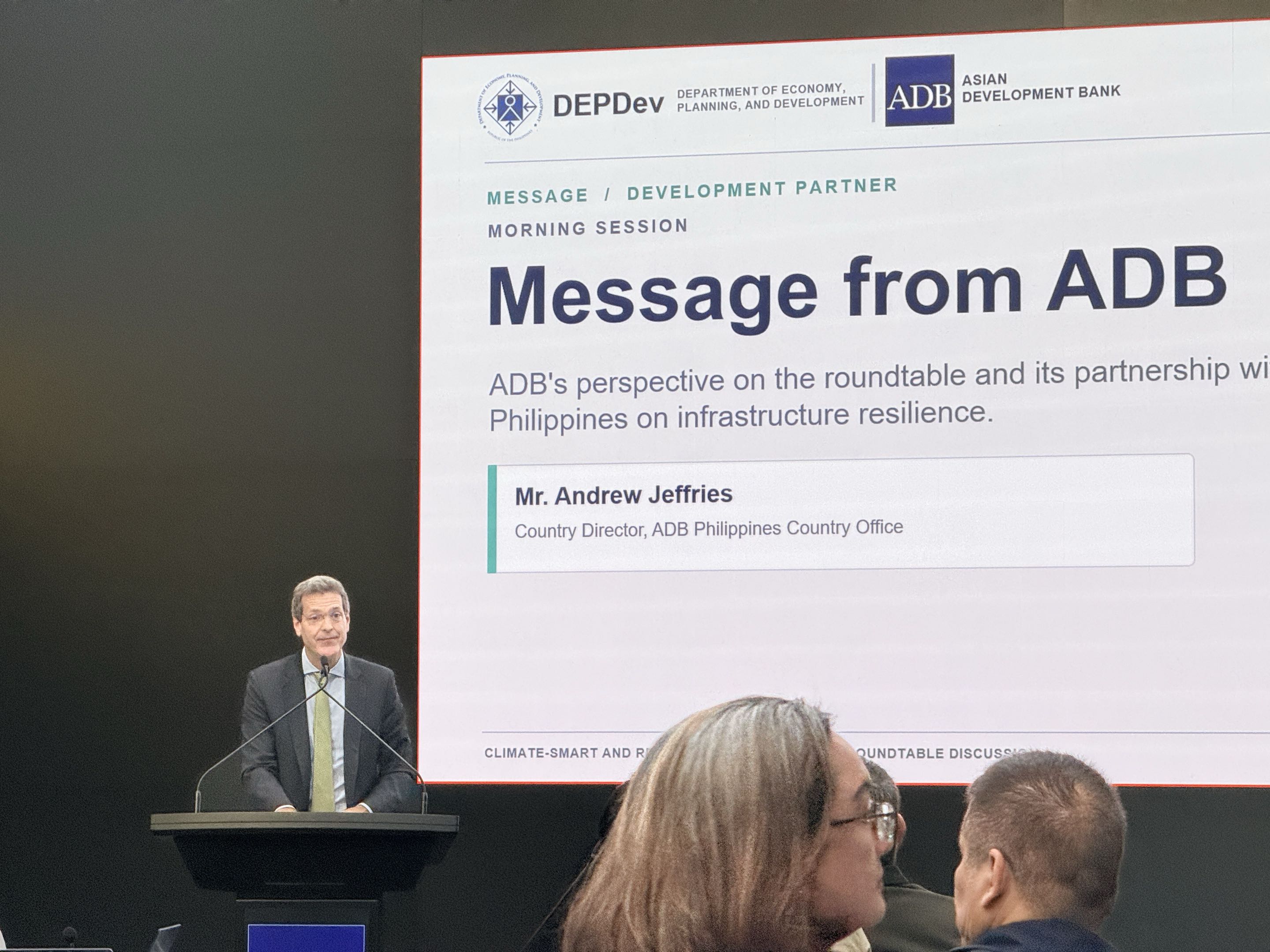
DEPDev Undersecretary Joseph J. Capuno (left) and ADB Philippines Country Director Andrew Jeffries (right) deliver the opening remarks during the Climate-Smart and Resilient Infrastructure Roundtable Discussion.
During the first part of the program, DEPDev presented its initiatives to strengthen infrastructure planning and resilience in the Philippines. These included Executive Order (EO) No. 72, series of 2024, which establishes an integrated and harmonized approach to infrastructure sector master planning, and the Comprehensive Infrastructure Development Master Plan (CIDMP). The presentations also covered the proposed Infrastructure Governance and Lifecycle Framework, which seeks to integrate resilience considerations throughout the infrastructure lifecycle, from strategic planning and project identification to construction, operation, maintenance, and eventual renewal or decommissioning.
The discussions emphasized the importance of integrating resilience considerations at the earliest stages of infrastructure development, rather than addressing them only during design and construction. Decisions on development areas, project site selection, and investment priorities can significantly influence the level of risk to which infrastructure will be exposed. Even well-designed and structurally sound infrastructure may remain vulnerable if located in hazard-prone areas. This underscores the need to integrate evidence- and science-based risk information into infrastructure planning to ensure that investments are strategically located and appropriately designed to address existing and future hazards.
The presentation of the Philippine Resilience Index (PRI) also stresses the importance of measuring resilience across different development sectors. In applying the index, indicators should adequately capture not only existing capacities, but also sectoral vulnerabilities and the ability of communities and institutions to prepare for, withstand, and recover from disasters. It was also emphasized that the indicators for assessing resilience need not be developed entirely from scratch, as relevant indicators are already available in existing local plans. These existing indicators can serve as reference points in applying the PRI, allowing the assessment to build on established local planning frameworks while identifying potential gaps in measuring resilience across sectors. This is particularly important in assessing resilience conditions before, during, and after disaster events.
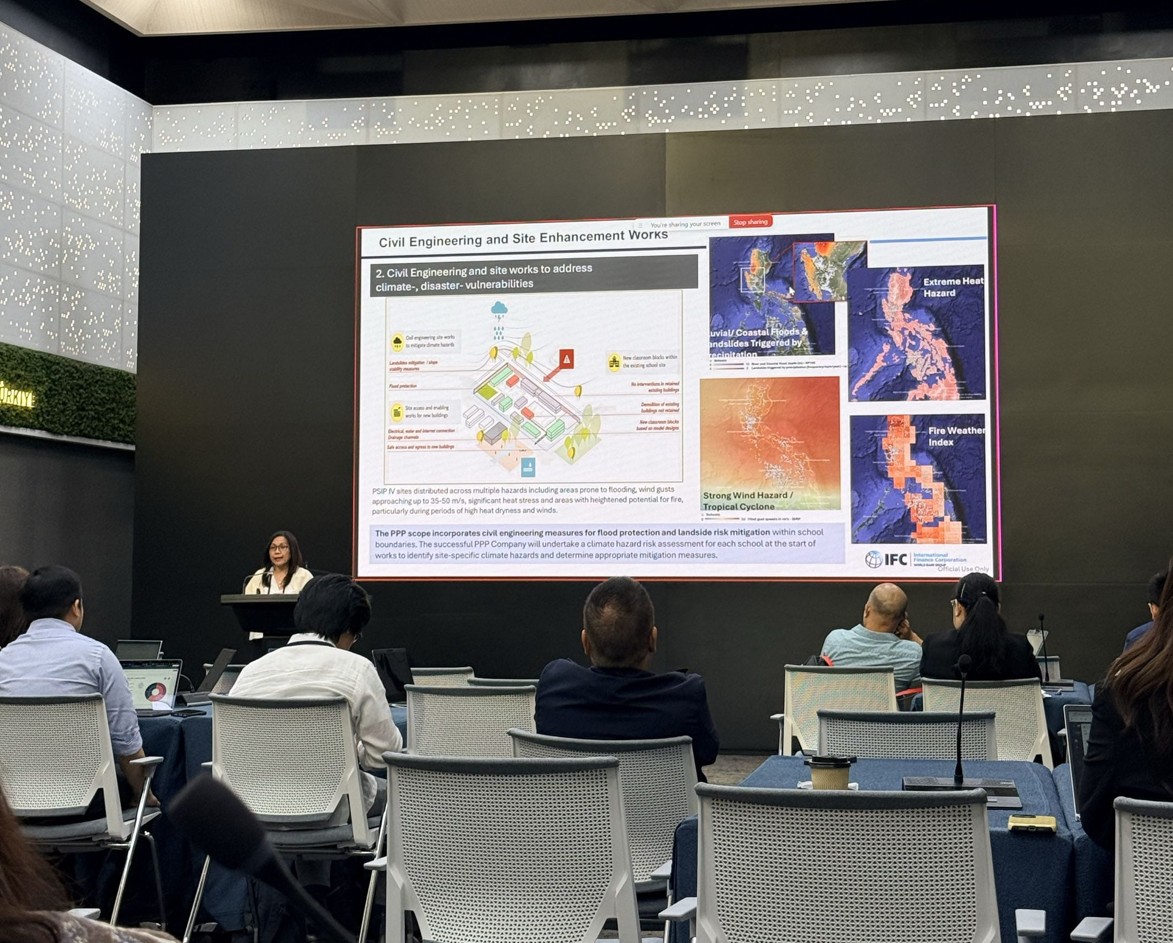
Ms. Lulu Baclagon, Senior Investment Officer for PPPs from the World Bank–IFC discusses civil engineering and site enhancement measures to address climate and disaster vulnerabilities.
To take the discussion further, development partners discussed disaster and climate risk screening, green and resilient building standards, climate-resilient social services, and investments in disaster risk reduction. ADB’s initiatives, including its earthquake risk modelling work, also present opportunities for technical exchange on how hazard-specific modelling approaches can complement existing risk assessment methods and inform infrastructure planning.
For UP RI-NOAH Center, these discussions underscore the importance of integrating hazard, exposure, vulnerability, and risk information into infrastructure and spatial planning. Through its work in climate and disaster risk assessment, geospatial analysis, and risk-informed planning, the institute can contribute scientific and technical inputs to support infrastructure site assessment, identify areas exposed to multiple hazards, and examine potential risks under changing climate conditions. These efforts can be further strengthened through collaboration with government agencies, academic institutions, and development partners to facilitate knowledge exchange, share technical expertise and resources, and translate scientific research into practical applications for infrastructure planning and decision-making.
Given that infrastructure investments are expected to serve communities for decades, risk assessments must also look beyond historical hazard events and present-day conditions. Considering projected climate scenarios can help planners anticipate risks and identify appropriate measures to strengthen the long-term resilience of infrastructure systems.
The roundtable discussion concluded with talks on potential partnerships and next steps, emphasizing the need to align technical assistance, knowledge products, financing mechanisms, and capacity-building initiatives with government priorities.
As DEPDev advances its efforts to institutionalize infrastructure resilience, collaboration with scientific and technical institutions such as UP RI-NOAH Center can help bridge the gap between risk information and development decisions. By bringing together scientific knowledge, geospatial tools, and planning expertise, UP RI-NOAH Center can contribute to ensuring that infrastructure investments are informed by existing and future risks and support the long-term resilience of communities.