
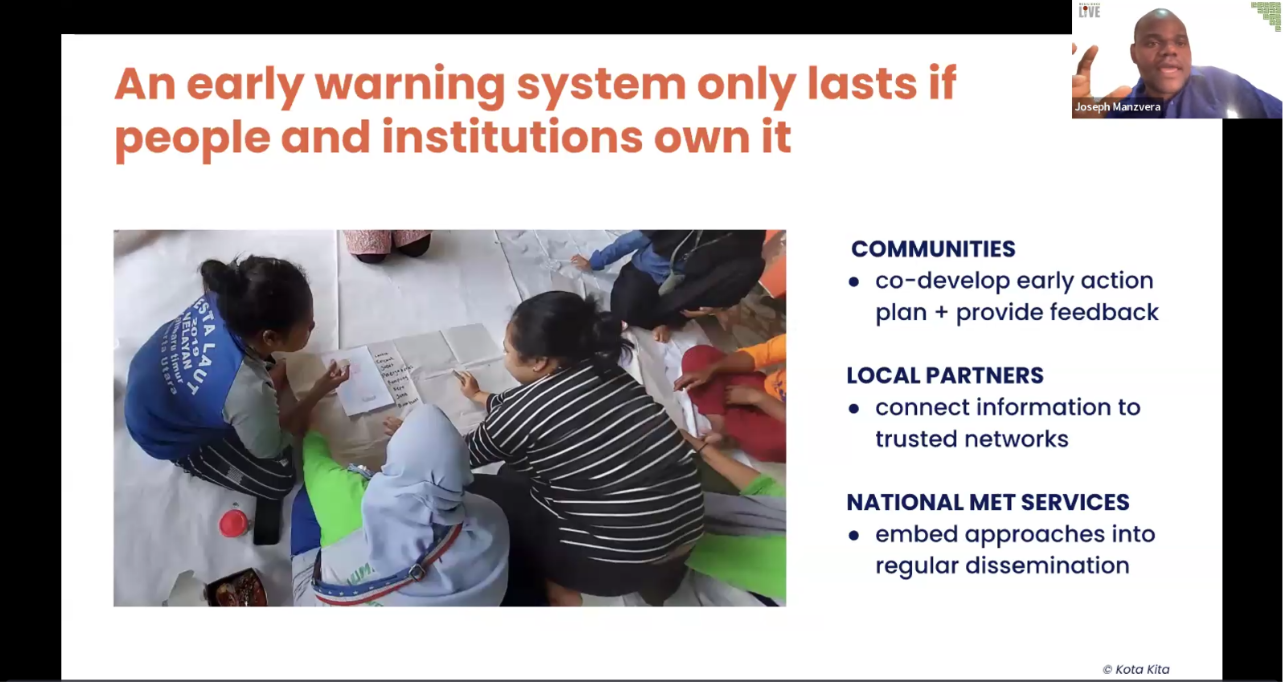
“An early warning system only lasts if people and students own it. It is very, very important to ensure that the system is people and community centered.”
Joseph Manzvera, Episode 23 Guest Speaker
“Better forecasts matter but better-connected institutions are what can help those forecasts keep creating value.”
Jennifer Joy Gadher, Episode 23 Guest Speaker
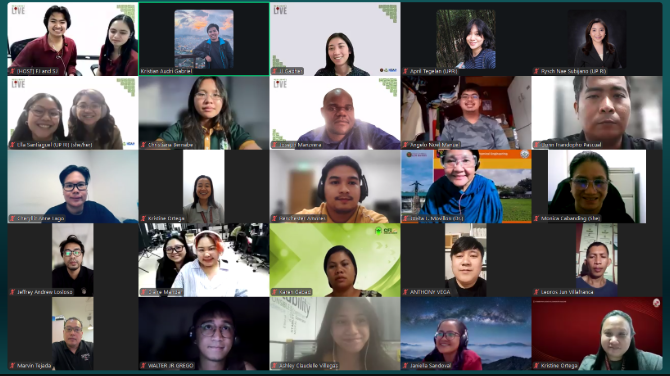
Ukulele music and street theater. Rain gardens and constructed wetlands. The purok, queer identity, and climate justice. There are many ways in which resilience can be achieved. Now in its third year, Resilience Live continues its commitment in mainstreaming resilience knowledge through diverse perspectives. For its third anniversary episode, the conversation explored both sides of the same challenge: how early warning information becomes impactful early action and how community-based interventions become sustainable systems.
Held on 27 August 2026, the anniversary episode featured Joseph Manzvera and Jennifer Joy Gadher of Resurgence, a United Kingdom-based non-profit social enterprise. Both speakers presented one of their organization’s initiatives called the DARAJA programme, which asks communities first what weather and climate information they need, whom they trust, how they understand information, and how they want to receive it. Drawing primarily from this, the speakers shared lessons on making early warning information more accessible, actionable, and sustainable.
Manzvera delivered a talk entitled “Beyond the Forecast: What Turns Early Warning Information into Action? Lessons from East Africa and Asia.” He highlighted how communities across East Africa, South and Southeast Asia face multiple hazards including floods, extreme heat, cyclones, tsunamis, landslides, and drought. When warnings arrive too late or are not understood, the consequences for populations may contribute to disease outbreaks, property damage, and decreased economic productivity.
The challenge, therefore, is not simply to produce accurate forecasts, but to close the gap between information and action. Forecasts may be technically sound yet fail to prompt early action when they are communicated in ways that communities cannot easily understand or use. This communication gap can be even more significant for persons with disabilities, who face the same hazards as other groups but often experience greater vulnerability. Unclear visuals, the lack of audio, complex language and technical terminology, and the lack of sign language interpretation make warnings less accessible.
The solution presented is to start with the community, not the forecast. When making information accessible, effective communication does not necessarily require creating new channels. The program instead works through channels that communities already use, i.e., messaging platforms, such as WhatsApp, SMS, and Telegram. Meanwhile, local climate champions and community leaders help simplify and relay forecasts directly to residents. Disaster mitigation interventions include public art and creative campaigns, schools and youth champions, community early-action plans, community radio, megaphones, phone-tree systems, and digital platforms.
DARAJA’s experience in East Africa points to five essential elements in early warning: understandable language, location-specific forecasts, simplified icons, community co-design, and trusted advice. Communities have also expressed a need for localized, actionable information in local dialects, practical guidance during extreme heat, and more inclusive communication for persons with disabilities, including visual information and sign language interpretation. But getting people to act on warnings is only one part of the challenge. The next question is whether these approaches can continue after a pilot or project ends.
Discussing the sustainability of early warning projects through productive partnerships, Gadher delivered a talk titled “From Pilots to Systems: Building the Partnerships Behind Scalable Early Warning”. Her presentation was anchored on a key insight, “A pilot proves that something can work, but it’s a system that decides whether it keeps working.” While pilots can demonstrate whether an approach works in a particular setting, scaling, she argued, requires answering three fundamental questions:
1.) Who has the mandate and relationships to carry the approach forward?
2.) Where does it fit within existing institutions, workflows, and budgets?
3.) What resources and capacities will sustain it after initial funding ends?
These questions shift the focus from proving that an innovation works to ensure that it can endure and create a lasting impact.
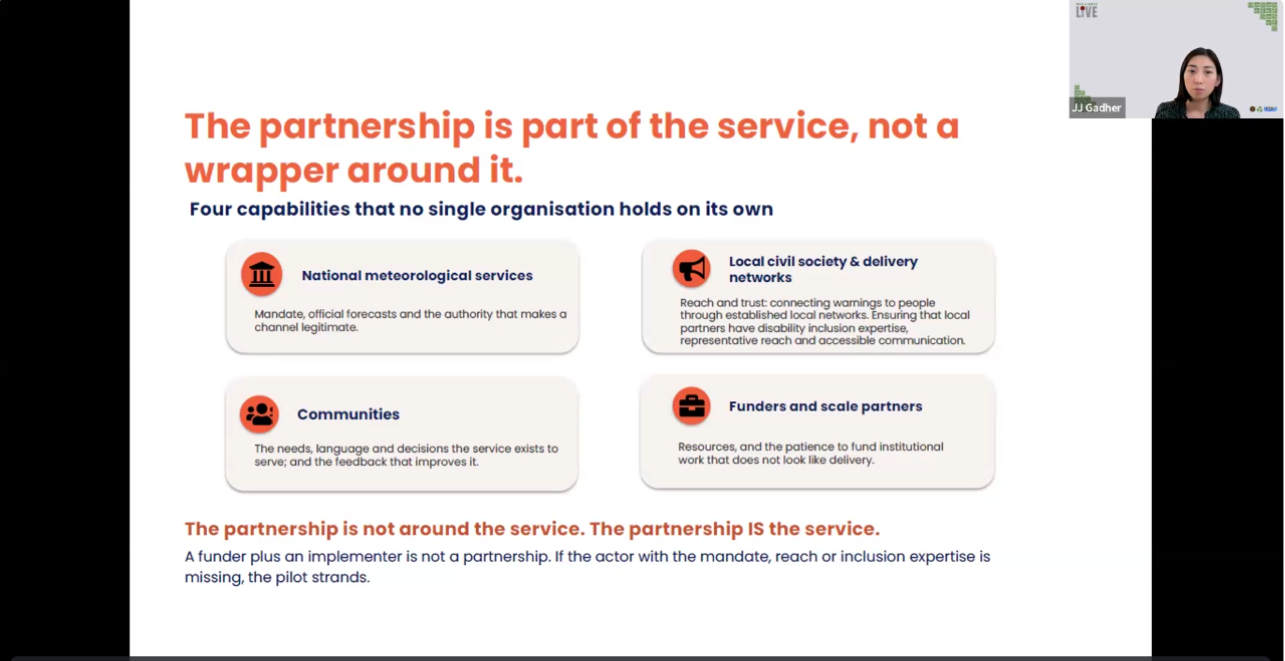
For Gadher, partnership is not simply something built around the service; it is part of the service itself. Sustainability requires institutions and communities to be involved from the beginning. Communities can co-develop early-action plans and provide feedback; local partners can connect warnings to trusted networks; and national meteorological and hydrological services can integrate approaches into regular dissemination. Engaging these actors during the design stage helps create systems that institutions and communities can actually own.
Evidence also plays an important role in determining what should be sustained. The programme’s baseline-to-endline findings across Kampala, Nairobi, Dar es Salaam, and Sudan showed improvements in access to warnings and their use for early action, although the gains were uneven across contexts. Gadher noted that the results are based on self-reported household data and should not be viewed as definitive proof of causality. Instead, they illustrate how local conditions shape the effectiveness of interventions. Variations across countries—particularly in conflict-affected Sudan—highlight the influence of factors such as institutional access, connectivity, trust, security conditions, and relationship-building. These findings reinforce that evidence is not merely about proving success. Evidence allows institutions to decide what to keep, what to adapt, and what may not work in a particular context.
That same emphasis on context shapes DARAJA’s work in the Philippines. Currently in a relationship-building and scoping phase, the initiative is engaging stakeholders to explore how a people-centered approach can complement existing systems. Recognizing the country’s strong institutions and extensive disaster risk reduction experience, the key question is not what can be introduced, but how an external partner can add value to what already exists.
Ultimately, the two presentations offered a shared message: effective early warning is not just a technical challenge. It is a communication, partnership, institutional, and ownership challenge. In the Philippines, the adoption of new technologies for disaster resilience are often celebrated and rightfully so. However, as Manzvera and Gadher emphasize, there must be robust systems and institutions that communicate hazard risk information to the affected communities. Going beyond the forecast means asking not only whether we can predict a hazard, but whether the warning reaches the right people, in the right way, at the right time.
In a similar way, Resilience Live goes beyond just a simple relaying of resilience knowledge. The series communicates information to ordinary people through interactive discussions between the guest speaker and the audience, breaking down the barriers to information accessibility. The series has seen a diverse set of practitioners, experts, communities, and partner organizations contribute to the success of each episode for the past three years. Thus, the series actualizes the lessons from Manzvera and Gadher on the importance of building rapport and developing sustainable partnerships with communities and other stakeholders in improving resilience.
Resilience Live returns in October for its 24th episode. In the meantime, watch the full Episode 23 discussion at https://www.youtube.com/watch?v=OcSpG04c3uA&t to learn more about lessons from the DARAJA programme’s implementation of early warning information systems in Africa and Asia.
Article written by: Stephany Joy Ayo and FJ Calvario