
by Gereka Garcia, Dr. DJ Darwin Bandoy, and Klara Bilbao
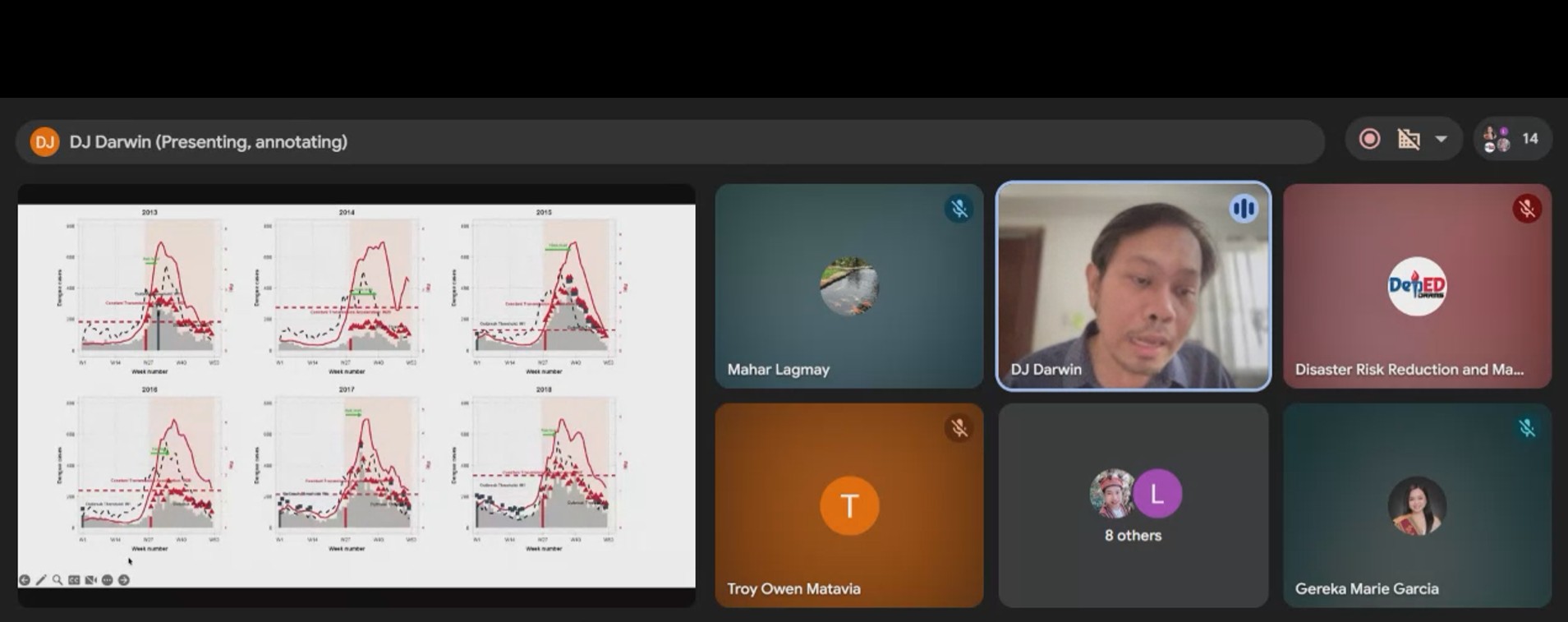
On April 24, the University of the Philippines Resilience Institute (UPRI) and the Department of Education Philippines (DepEd), together with UPRI Executive Director Dr. Mahar Lagmay, Dr. Miguel Angelo S. Mantaring, Director IV of the Bureau of Learner Support Services (BLSS), and his team, Director Felino O. Castro V of the Disaster Risk Reduction and Management Service (DRRMS), as well as Dr. Darwin Bandoy and his team, including Ms. Gereka Garcia and Mr. Troy Matavia, held an engagement highlighting ongoing work on dengue to advance proactive, science-based approaches to public health and disaster preparedness in schools, particularly through dengue outbreak detection research.
Leading the discussion, Dr. Darwin Bandoy of UPRI–RCW presented the team’s work under the Center for Climate and Health Global Research on Disasters (CORD) on dengue outbreak detection—an evolving body of research aimed at shifting response strategies from reactive to anticipatory. Developed in collaboration with local government units and national health agencies, the initiative responds to critical gaps in how dengue outbreaks are currently identified and managed in the Philippines.
Current dengue outbreak thresholds, adapted from older models, often detect outbreaks too late—when cases are already declining. UPRI–RCW under CORD is developing a STA/LTA-based approach from seismology that identifies early transmission acceleration, providing an estimated 8–9 week lead time before peak cases. This allows earlier interventions such as mosquito control, health communication, and testing, helping address dengue case fatality rates that can reach 6–8% during outbreaks.
Beyond predictive analytics, Dr. Bandoy emphasized the importance of effective science communication. The RCW team under CORD has also developed AI-assisted, culturally grounded educational materials designed to make complex health information more accessible, particularly for students and communities. These materials are being explored for integration into DepEd platforms, including DepEd TV, to support disaster risk reduction and climate change education.
DepEd representatives from the Bureau of Learner Support Services and the School Health Division expressed strong interest in piloting the system, particularly in Quezon City, where robust datasets are available. The proposed collaboration focuses on school-based interventions, including early triage for students presenting with fever, strengthened health education, and preventive measures such as eliminating mosquito breeding sites.
The discussion also opened opportunities for deeper integration between UPRI–CORD and DepEd systems, enabling faster data exchange and more responsive decision-making. Existing tools, such as flood monitoring platforms and customized dashboards, demonstrate the potential for scaling science-based solutions across sectors.
As climate-driven health risks continue to evolve, initiatives under CORD highlight the importance of bridging research, policy, and practice. Through the leadership of Dr. Bandoy and the RCW team, UPRI continues to advance data-driven, actionable approaches that bring early warning and preparedness closer to the communities that need them most.