
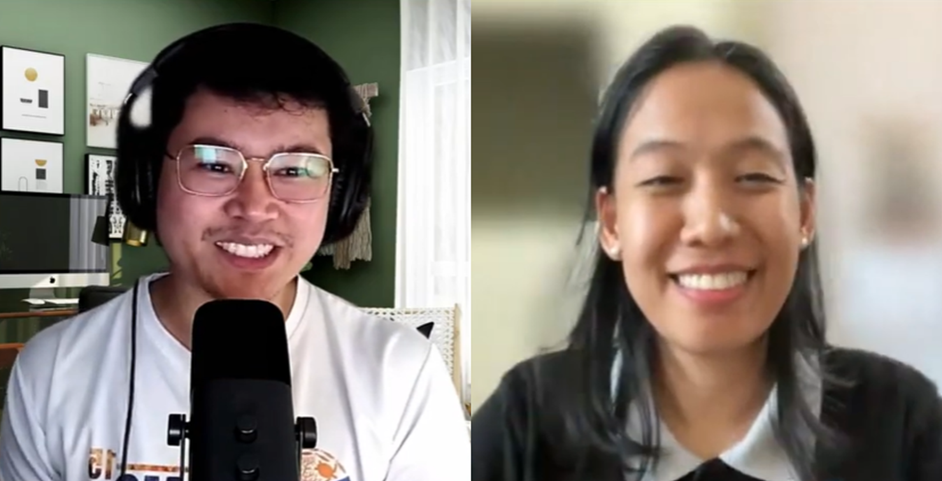
Rain-induced landslides along Benguet’s busy mountain roads may soon be more predictable, thanks to a new machine learning model developed by geologist and educator Ms. Jamila Abuda and featured in the 121st episode of the Behind the Science podcast.
About the episode
In this episode, host Dr. Paul Flores talks with Ms. Abuda, an instructor at Eastern Visayas State University and former UP Diliman NIGS faculty member, about her MS Geology research on predicting when rain-induced landslides are likely to occur. Drawing on a decade of experience as an exploration and mine geologist in Northern Luzon, she explains how real-world slope failures in mining areas sparked her interest in landslide science and, eventually, in temporal prediction models.
Predicting when landslides will occur
Traditional landslide maps in the Philippines focus on where landslides are likely to happen; Ms. Abuda’s work instead asks when they are likely to occur along the Benguet First Engineering District road network, which surrounds Baguio City and carries heavy traffic to and from this economic hub. Using daily rainfall data, a five-year record of landslide and non-landslide days from DPWH maintenance logs, and lithology (rock type), she built models that flag potentially hazardous days based on rainfall patterns.
A key innovation is her “lithologically constrained” approach: instead of one model for the whole district, she trains separate models for volcanic, sedimentary, and intrusive rock units to account for how different rocks respond to rainfall. Because landslides are rare compared to days without events, she uses resampling techniques to balance the dataset, then tests several algorithms and finds that Random Forest performs best for this problem.
Open-source tools, fieldwork, and data gaps
The study relies entirely on open-source software, making the method replicable in other data-limited regions. Field validation and ground-truthing in Benguet were supported by a modest UP NIGS research grant, which covered lean field campaigns that often depended on a hired driver who doubled as field assistant and photographer.
One of the biggest challenges was turning DPWH road maintenance records into a usable landslide inventory. Ms. Abuda had to carefully interpret remarks, consult DPWH manuals and engineers, and adopt conservative criteria to distinguish true landslides from tree falls or other obstructions, highlighting how underutilized operational datasets can still power useful hazard models when systematically processed.
A late shift into coding and science communication
The episode also traces Ms. Abuda’s path from being one of only two women in her UP BS Geology batch to spending ten years in mining, shifting into teaching after the pandemic, and learning to code in Python over roughly two years with the help of online courses and close mentoring. She candidly shares how she worked through impostor syndrome and emphasizes that coding and AI-based methods are accessible even to researchers without a tech background, provided they are patient and willing to iterate.
Beyond publishing the work, she stresses the importance of communicating science in languages and formats that communities can relate to. For this project, she translated her abstract into English, Filipino, and Waray, and experimented with a comics version of her study, underscoring her belief that research on landslides and other hazards should ultimately serve the people most at risk.
Youtube: bit.ly/btspodcast-yt
Spotify: bit.ly/btspodcast-spotify
Facebook: https://bit.ly/btspodcast-fb
Research Spotlight:
Abuda, J.B., Saturay, R.M., Catane, S.G. et al. Lithologically-constrained, machine learning-based temporal landslide prediction models using rainfall time series for the Benguet First Engineering District, Philippines. Bull Eng Geol Environ 85, 156 (2026). https://doi.org/10.1007/s10064-025-04764-4
Do you want to nominate a scientist in the field of DRR and geosciences to be featured on the Behind the Science Podcast? Or, have you read an author’s publication whose behind-the-scenes story you are eager to hear about? Email us at upri.educ@up.edu.ph, and we will do our best to feature them on the BTS Podcast!