
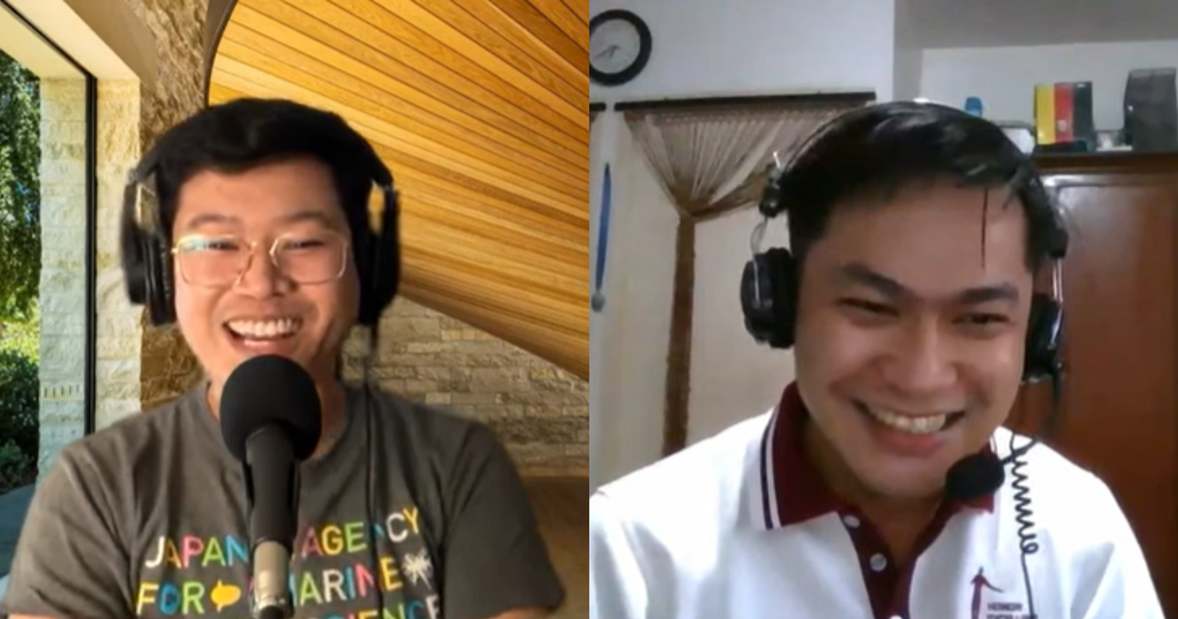
Episode 95 of the Behind the Science Podcast Series features Mr. Gifford Agudo, who shared insights from his research on land cover changes in the Quinali A Watershed in Albay over the past three decades. The results revealed that human activities have transformed the watershed’s natural landscape, with increases in farmland, roads, buildings, and water-covered areas, while forests and open lands have steadily declined. Understanding these changes, Mr. Agudo emphasized, is key to making smart, science-based decisions, managing land use responsibly, protecting water resources for both communities and nature, and reducing the risk of flooding.
The research is part of a larger project focused on analyzing multiple hazards in the watershed to create a multihazard map, an approach that has not been widely explored in the Philippines. By combining land cover data with flood hazard maps, Mr. Agudo and his team were able to see how human development and landscape changes interact with natural hazards, providing valuable insights for planning and risk reduction. Analysis of 30 years of data shows that these changes have been driven mainly by urbanization, which continues to fragment areas of high forest cover and reduce their ability to serve as natural buffers against floods and storms.
With the Quinali A Watershed exposed to typhoons, flooding, landslides, and volcanic activity, the findings offer crucial guidance for local policymakers as they work toward using land more sustainably without sacrificing environmental resilience. The researchers stress the importance of science-based planning, continuous monitoring, and informed land-use decisions to reduce flood risks and protect communities.
A major part of Mr. Agudo’s research methodology involved the use of satellite remote sensing data from Landsat, which allowed the team to analyze forests, farmlands, brushlands, and built-up areas at 10-year intervals from 1990 to 2020. His interest in remote sensing began with simple curiosity, sparked by reading geographic magazines that showed how forests and landscapes could be studied using satellite images without the need for direct fieldwork. During his college years, he was introduced to remote sensing through basic map-making activities, which laid the foundation for his later work. This approach helped him explore that croplands, urban areas, inland water, and submerged vegetation expanded, while forests, brushlands, and barren lands steadily declined, marking a significant transformation of the watershed’s landscape through the years.
Growing up, Mr. Agudo did not plan to become a scientist and initially wanted to follow in his father’s footsteps as an auto mechanic, coming from a family without scientific background. His interest in research grew after he received a scholarship from the Department of Science and Technology (DOST) in 2019 in Cebu, where he was inspired by mentors and scientists studying forests and conducting research around the world. He also points out a common challenge in the Philippines: the lack of visible Filipino scientist role models, and hopes that platforms like the podcast can help encourage the next generation of Filipino researchers. Mr. Agudo encourages aspiring researchers to develop a strong reading habit early on, noting that regular exposure to scientific papers helps build familiarity with their technical nature and strengthens critical thinking over time.
By showing how decades of land changes affect flooding, Mr. Agudo’s work not only guides smarter land use in the Quinali A Watershed but also serves as an example for future Filipino scientists to explore, question, and use science to protect both communities and the environment.
Youtube: bit.ly/btspodcast-yt
Spotify: bit.ly/btspodcast-spotify
Facebook: https://bit.ly/btspodcast-fb
Research Spotlight:
Agudo GJ, Garcia J, Pulhin J, Mendoza J, Singson KV, Lagmay AMF, Cruz RV, Santiago J, Moises MA, Esquivel ALJ, et al. 2025. Land Cover Change and Its Associated Impacts on Landscape Fragmentation and Flood Exposure in Quinali A Watershed, Albay, the Philippines. Philippine Journal of Science. 154(2): 287-300. https://doi.org/10.56899/154.02.06
Do you want to nominate a scientist in the field of DRR and geosciences to be featured on the Behind the Science Podcast? Or, have you read an author’s publication whose behind-the-scenes story you are eager to hear about? Email us at upri.educ@up.edu.ph, and we will do our best to feature them on the BTS Podcast!