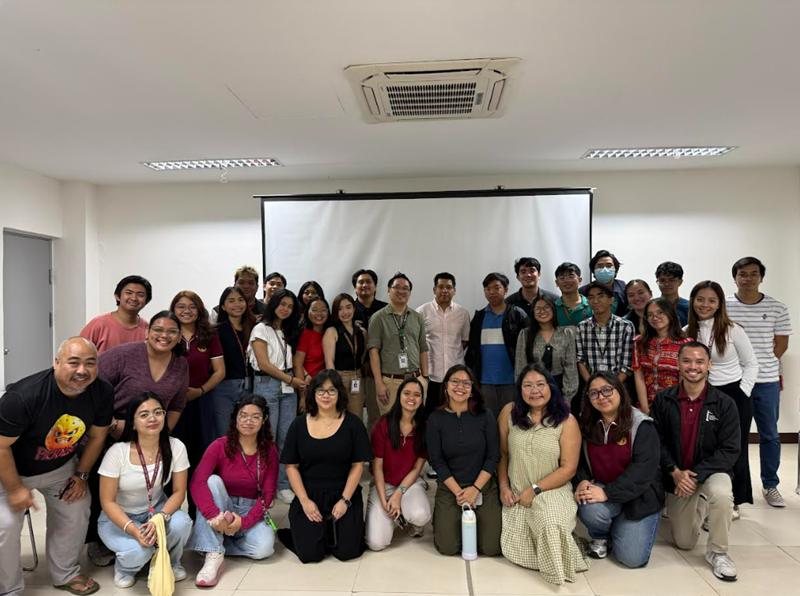
On 25 June 2026, the UP Resilience Institute held the talk “Can We See Poverty? Visual Prediction, Machine Learning, and the Limits of Household Targeting in Mexico” at the UPRI Training Room. The session was led by Dr. Alan Hernández-Solano, Research Professor at EQUIDE of Universidad Iberoamericana in Mexico City, and attended by around 40 UPRI staff and interns.
Dr. Hernández-Solano presented recent work using Google Street View imagery and satellite data to predict household-level income poverty in Mexico. His study applies deep learning and other machine learning algorithms to visual features such as building quality, vegetation coverage, and texture, combined with climate and nighttime lights indicators, to classify households as poor or non-poor across Mexico’s main economic regions.
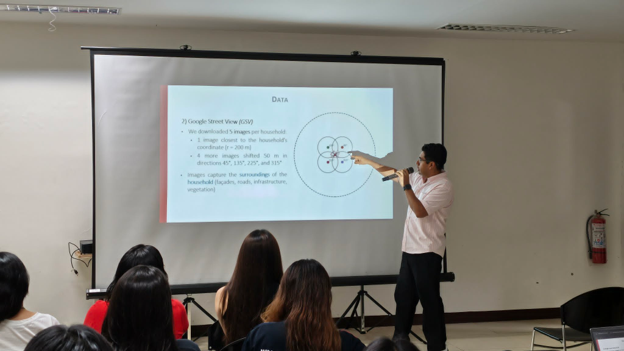
The talk showed that remote sensing imagery contains genuinely relevant information for poverty measurement, but also underscored important limits. While models can correctly identify a high share of poor households at aggregate and regional scales, their performance varies by region and does not necessarily improve when more visual datasets are combined. Dr. Hernández-Solano emphasized that visual signals of poverty can be subtle and context-dependent, requiring careful calibration to local conditions and existing survey data. He also highlighted the risk of relying solely on automated visual prediction for household targeting, given possible misclassification and exclusion errors in real-world social protection
In the open forum, UPRI staff and interns focused on the challenge of data scarcity, especially in settings where up-to-date household surveys are limited. Participants asked how visual cues around the house, such as surrounding vegetation, the quality and mix of construction materials, and other observable features, could serve as additional reference indicators to strengthen model predictions. Questions also explored how to infer household composition, including whether only one family is living in a dwelling or multiple families share the same structure, using available imagery and ancillary data. These concerns highlighted the importance of combining machine learning outputs with local knowledge and field validation to avoid misinterpretation of visual signals of poverty.
In his closing remarks, UPRI Chief Science Research Specialist Richard Ybañez reflected on parallels between Mexico and the Philippines. He noted that both countries face persistent data gaps and high levels of poverty, which complicate accurate targeting of social protection and resilience programs. Ybañez stressed that UPRI’s work on disaster risk reduction and climate resilience can benefit from emerging visual and machine learning approaches.