
“The policy framework is already aligned. The [Nature-based Solution] methods are benchmarked and proven. What we need now is institutional support.”
Amancio Melad III, Resilience Live Episode 21 Guest Speaker
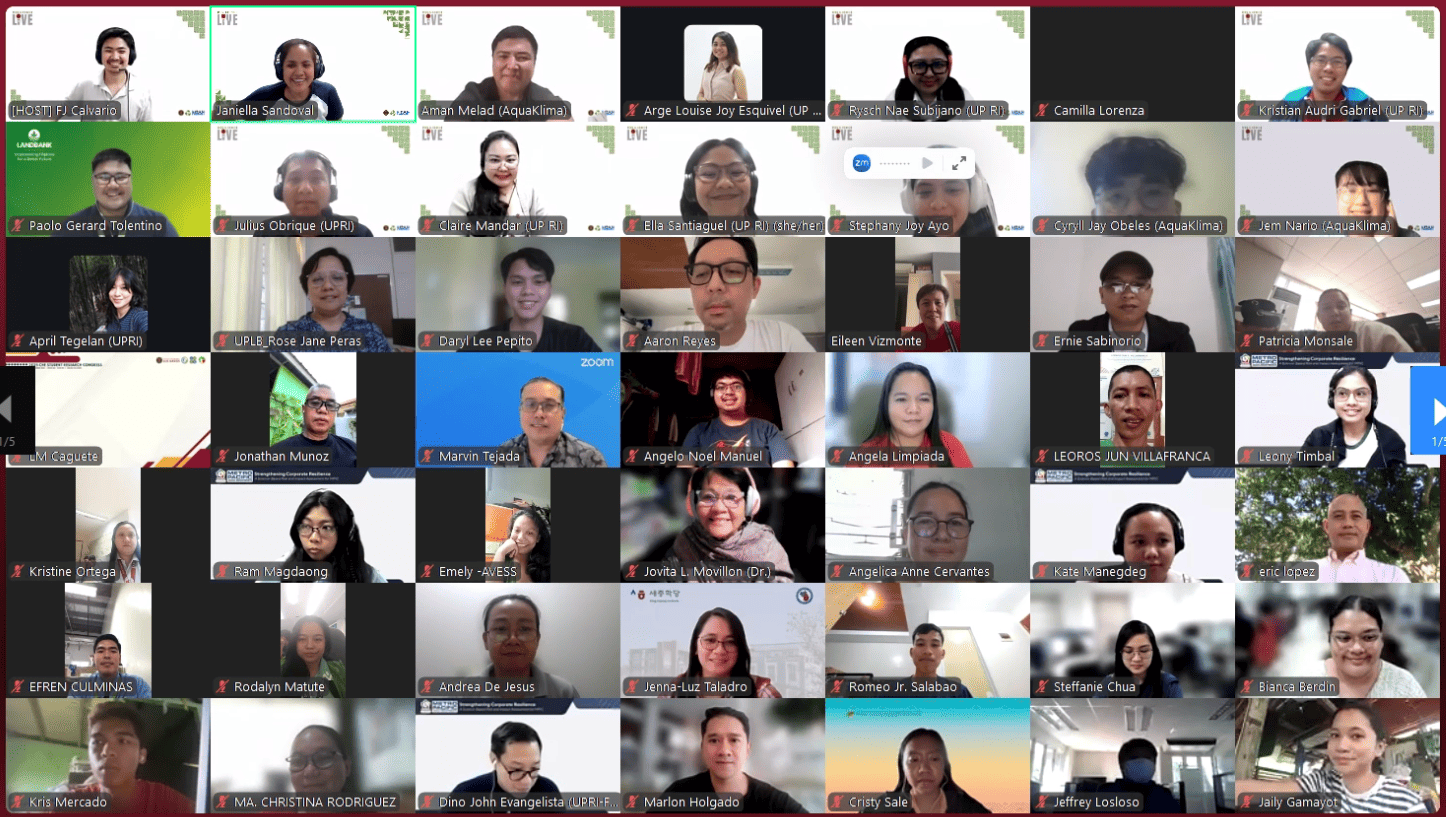
On April 30, the Resilience Live webinar series premiered its 21st episode titled “From Policy to Case Implementation: Designing Nature-Based Solutions for Bayawan Water District and Philippine Ecozones”, featuring Amancio Melad III as the guest speaker. Melad is currently the Managing Director of Aqua Klima Inc., a water and climate resilience consulting firm based in Muntinlupa.
With April recognized as the Month of Planet Earth, Melad’s talk centered on Nature-Based Solutions (NbS). As defined by the United Nations Environment Assembly (UNEA), NbS are “actions that protect, restore, and sustainably manage ecosystems”, addressing ecological issues in society. The talk highlighted the transition of NbS from policy framework concepts to operational practice, in the context of local water supply management. Aqua Klima has undertaken several benchmarking activities for NbS designs implemented in several countries, such as the Netherlands, United Arab Emirates, and Indonesia, and sought to apply them in the Philippine context.
Two areas for NbS design implementation were examined: the Freeport Area of Bataan (FAB) and Bayawan City, Negros Oriental. Both locations currently face several environmental problems in their water supply and management. The FAB contends with marine pollution and oil spills, mangrove habitat and coastal community loss, groundwater depletion, and water quality degradation. Meanwhile, Bayawan faces unpredictable rainfall patterns, deforestation, agricultural and urban settlement expansion, and soil degradation.
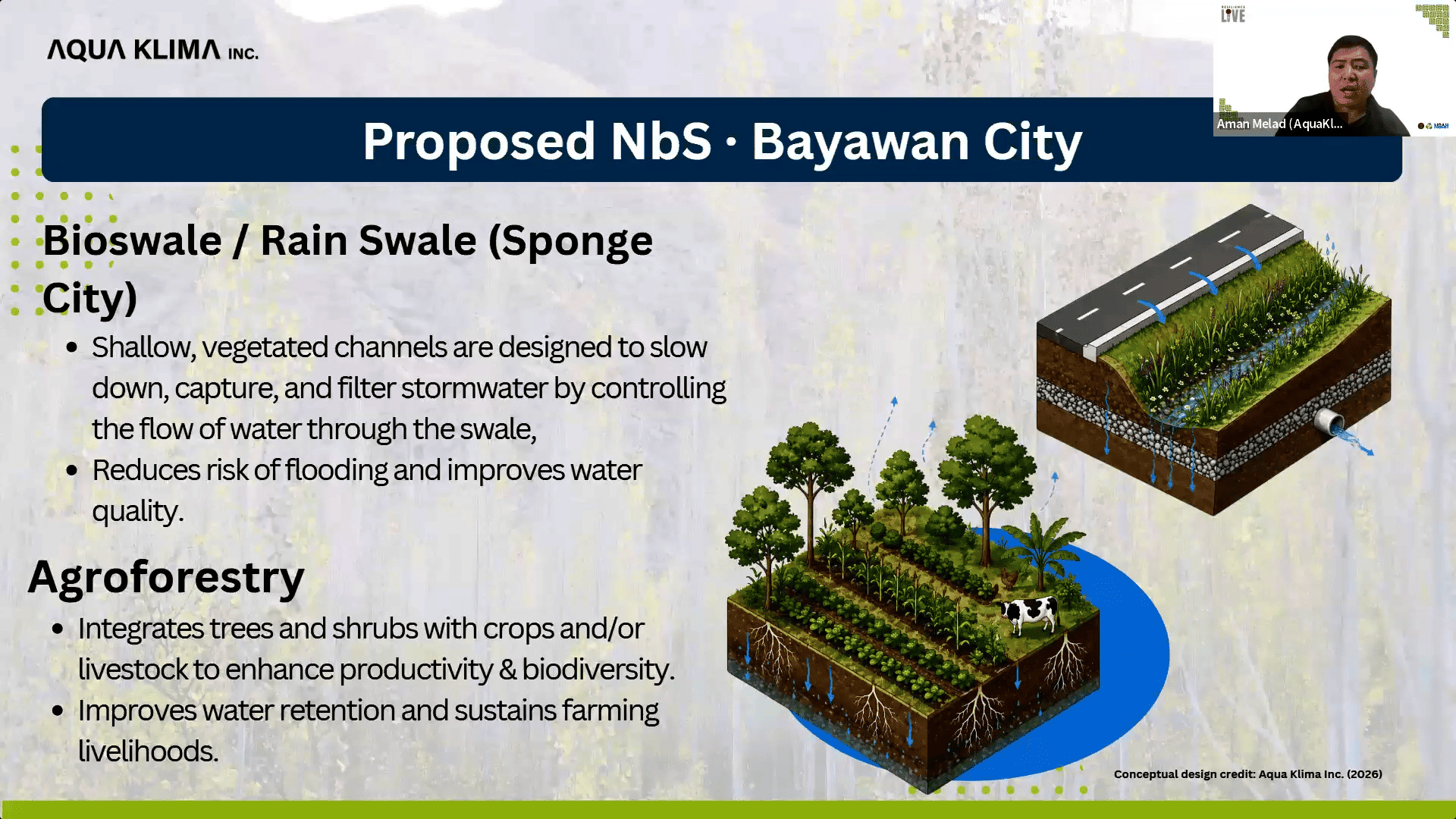
To combat the compounding impact of these problems on water management, Aqua Klima proposed a few NbS methods for each site such as “Mangrove Restoration” and “Constructed Wetland” for FAB, and “Sponge City” and “Permeable Pavement” for Bayawan. For each NbS method design, Melad stressed the designs’ observance of the International Union for Conservation of Nature (IUCN) standards, as well as their alignment with local development policies such as the Philippine Development Plan, the Central Luzon Regional Development Plan, and the Manila Bay Rehabilitation Program. Each design also considered the environmental context of the site. For instance, proposed designs for FAB integrate the local industrial zone’s draining structure to solve metal-laden waste in water. Meanwhile, one proposed design for Bayawan considers its riverine landscape by utilizing shallow, vegetated channels for capturing rainwater.
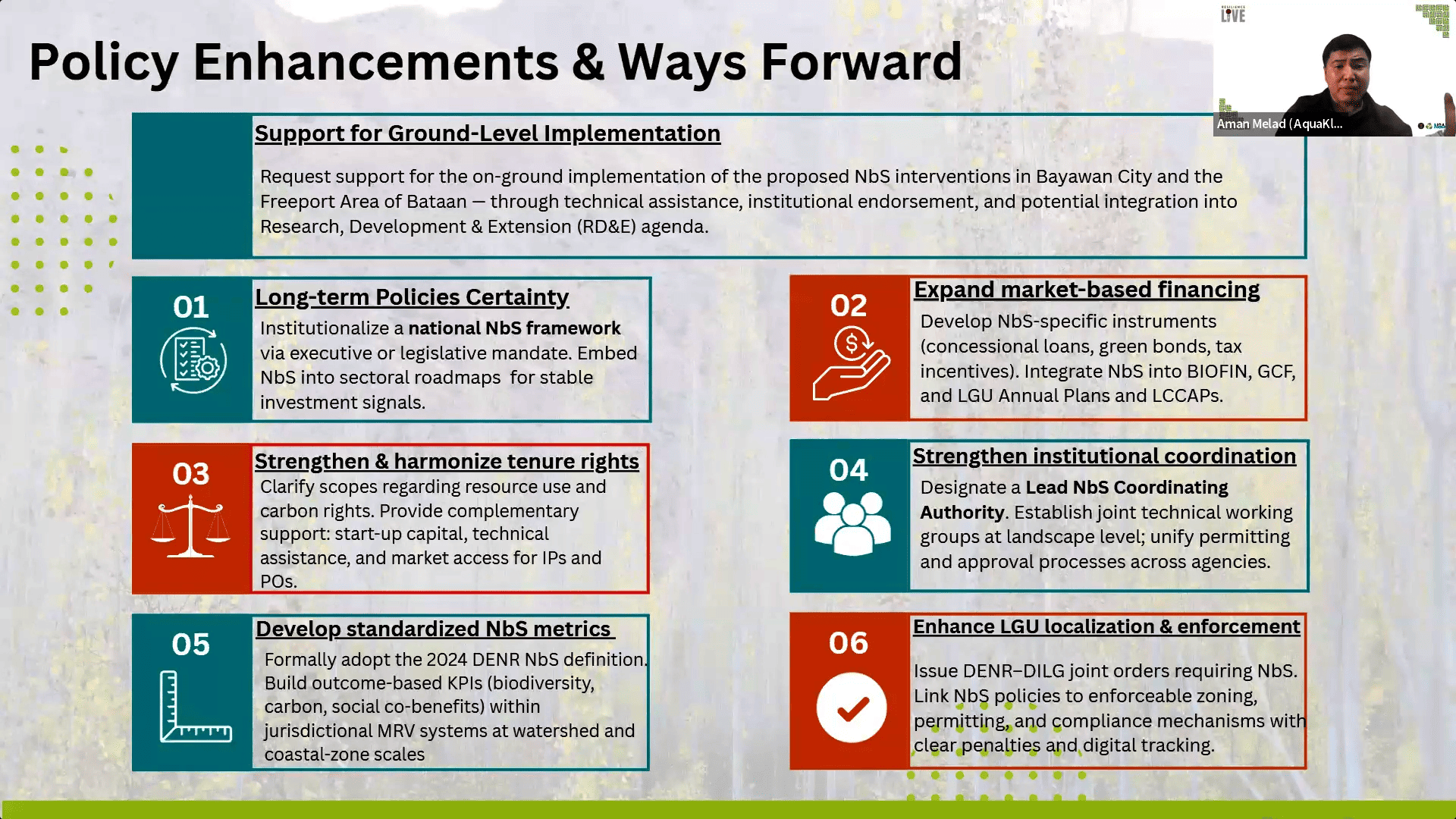
The talk concluded with recommendations on improving policy and ground-level implementation. Melad advocated for the institutionalization of a national NbS framework through executive order or legislation, the expansion of market-based financing (e.g., concessional loans, tax incentives), the harmonization of tenure rights, and the strengthening of institutional coordination.
The open forum segment saw a lively discussion with the audience on the implementation of NbS in local contexts. Melad underlined the necessity of engaging with various stakeholders, such as community leaders and local officials, and obtaining their support, since NbS implementation must be community-based for effective monitoring and evaluation. He also discussed concerns regarding jurisdiction on NbS projects in riverine areas in the Philippines, mentioning the existence of river basin organizations and the mandate of the Department of Environment and Natural Resources (DENR).
The timeliness of Melad’s call for mainstreaming NbS projects cannot be overstated. As global temperatures increase year after year due to environmental degradation, the Philippines bears the brunt of this worsening climate crisis with stronger typhoons and high heat indices. Thus, the implementation of mitigating efforts such as NbS is necessary as ever. But the proposed NbS designs do not rely on unproven, high-cost, or wasteful technology but rather on mandated scientific standards and existing ecosystems in various countries. All it takes is political will and institutional support for NbS.
Resilience Live will return in June to celebrate Pride Month. In the meantime, you can watch Episode 21 here: https://www.youtube.com/watch?v=vz7dY-L_xgM
Article written by: FJ Calvario