
By Ma. Shara Micah Oliquino, UP RI Education Division
The Fundamentals of Resilience Massive Open Online Courses (FoR MOOCs) once again achieved a significant milestone following the completion of MOOC 3: Overview of Policies and Strategies for Climate and Disaster Resilience and MOOC 4: Resilience Strategies Across the Four Pillars, which ran from 20 April to 15 May 2026.
During the third offering of the courses, 2,859 learners successfully completed MOOC 3, while 2,758 learners completed MOOC 4, resulting in completion rates of 56.95% and 51.77%, respectively. These figures represent the highest number of completers recorded since the launch of the FoR MOOCs in 2024, demonstrating sustained learner engagement and growing interest in resilience education. Enrollees during this iteration came from diverse sectors and professional backgrounds across the country. Participation from key institutional partners, particularly the Department of Education (DepEd) and the Department of Social Welfare and Development (DSWD), remained substantial with a total combined of 1,887 participants. Earlier this year, the FoR MOOC 1: Basics of Resilience and MOOC 2: Hazard and Risk Assessment Fundamentals (January-February run) likewise recorded strong participation from these agencies, suggesting a continuing commitment to strengthening climate and disaster resilience capacities among their personnel and stakeholders.
This iteration also marks the conclusion of the first cycle of the 2026 FoR MOOCs, which covered all four courses in the series. The strong completion figures and sustained institutional participation across all these courses highlight the growing role of the FoR MOOCs as an accessible platform for resilience learning and capacity development among government agencies, educational institutions, and the broader public.
ABOUT THE LEARNERS
a. Geographic Reach of Learners 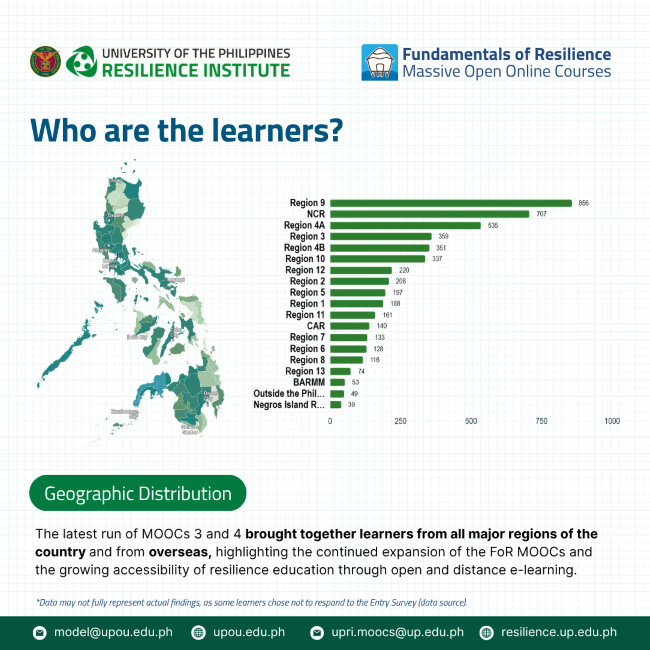
The latest run of MOOCs 3 and 4 attracted learners from across the Philippines and beyond, underscoring the continued accessibility of the FoR MOOCs as a platform for resilience education. Participation was recorded across all major regions of the country, with Region 9, the National Capital Region, Region 4A, Region 3, and Region 4B emerging as the top five regions in terms of enrollment. The broad geographic distribution of learners demonstrates the program’s expanding reach and its capacity to make resilience education accessible to Filipinos across diverse geographic settings, including underserved and geographically isolated communities.
The courses likewise reached international learners, further expanding the FoR MOOCs’ audience beyond national borders. This growing global participation reflects the universal relevance of climate and disaster resilience and highlights the role of open and distance e-learning (ODeL) in connecting learners across different geographic and cultural contexts.
b. Gender Identity of Learners 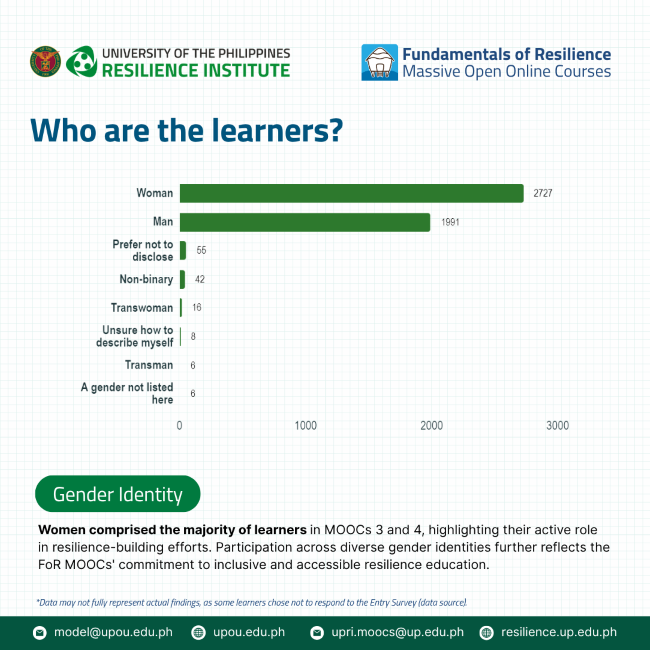
The courses attracted a diverse learner population in terms of gender identity, with women comprising the majority of participants at 2,727 learners, followed by 1,991 learners who identified as men. The strong representation of women underscores their important contributions to disaster preparedness, climate action, and resilience-building efforts. Participation from learners across a range of gender identities further reflects the FoR MOOCs’ commitment to fostering inclusive learning spaces that support resilience for all.
c. Age Distribution of Learners 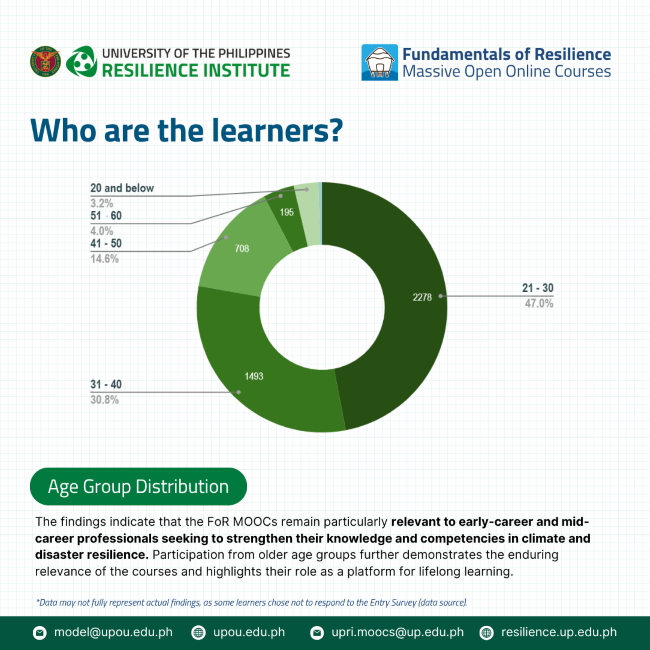
The largest proportion of learners belonged to the 21–30 age group, representing approximately 47% of the overall sample population. This was followed by participants aged 31–40 years, who accounted for nearly 31% of learners. The findings indicate that the FoR MOOCs remain particularly relevant to early-career and mid-career professionals seeking to strengthen their knowledge and competencies in climate and disaster resilience. Participation from older age groups further demonstrates the enduring relevance of the courses and highlights their role as a platform for lifelong learning.
The presence of learners from different generations also reflects the broad appeal of resilience education and enriches the learning experience through the exchange of diverse perspectives, experiences, and insights on resilience-building.
d. Work Affiliation of Learners 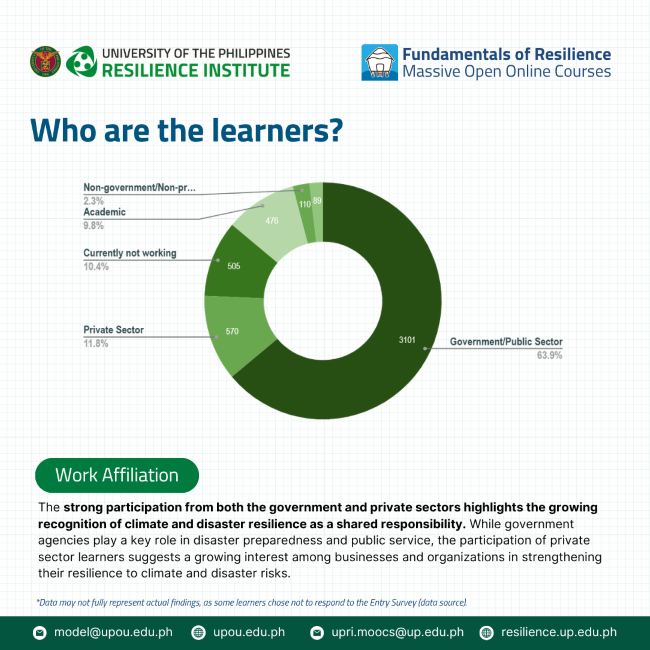
Government and public sector personnel comprised the largest group of participants, accounting for nearly 64% of learners. This was followed by representatives from the private sector, academe, non-government organizations, and individuals currently not working. The strong participation from both the government and private sectors highlights the growing recognition of climate and disaster resilience as a shared responsibility. While government agencies play a key role in disaster preparedness and public service, the participation of private sector learners suggests a growing interest among businesses and organizations in strengthening their resilience to climate and disaster risks.
e. Years of Professional Experience of Learners 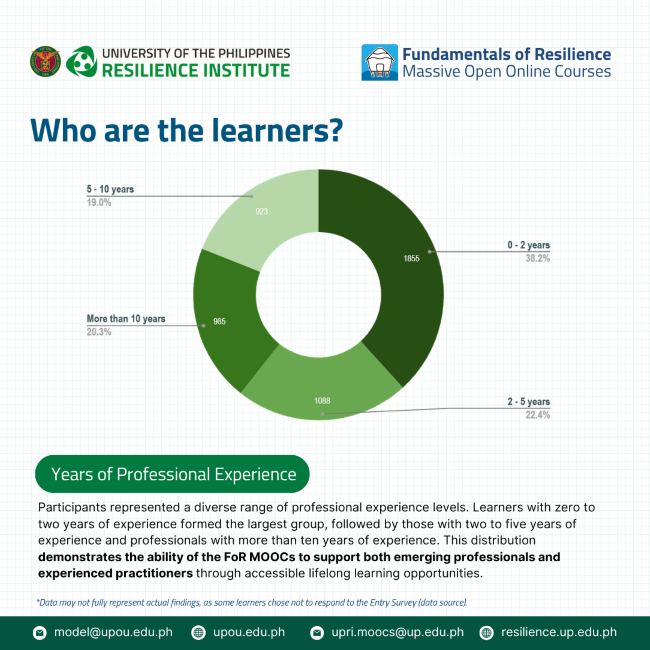
Participants represented a diverse range of professional experience levels. Learners with zero to two years of experience formed the largest group, followed by those with two to five years of experience and professionals with more than ten years of experience. This distribution demonstrates the ability of the FoR MOOCs to support both emerging professionals and experienced practitioners through accessible lifelong learning opportunities.
f. Highest Educational Attainment of Learners 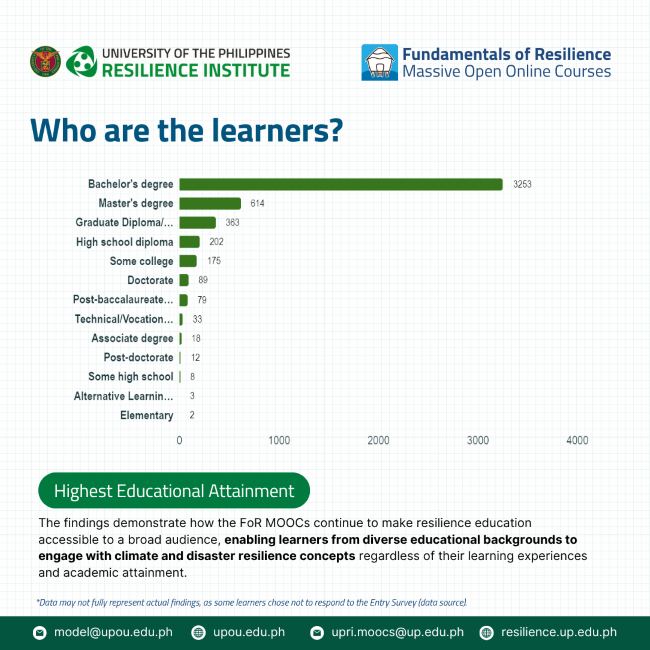
Most participants hold a bachelor’s degree, with 3,253 learners falling under this category. Substantial numbers likewise reported possessing graduate-level qualifications, including master’s and doctoral degrees. Learners with other educational backgrounds were also represented, underscoring the accessibility of the FoR MOOCs to individuals with varying levels of formal education.
The findings demonstrate how the FoR MOOCs continue to make resilience education accessible to a broad audience, enabling learners from diverse educational backgrounds to engage with climate and disaster resilience concepts regardless of their academic attainment.
g. Employment Status of Learners 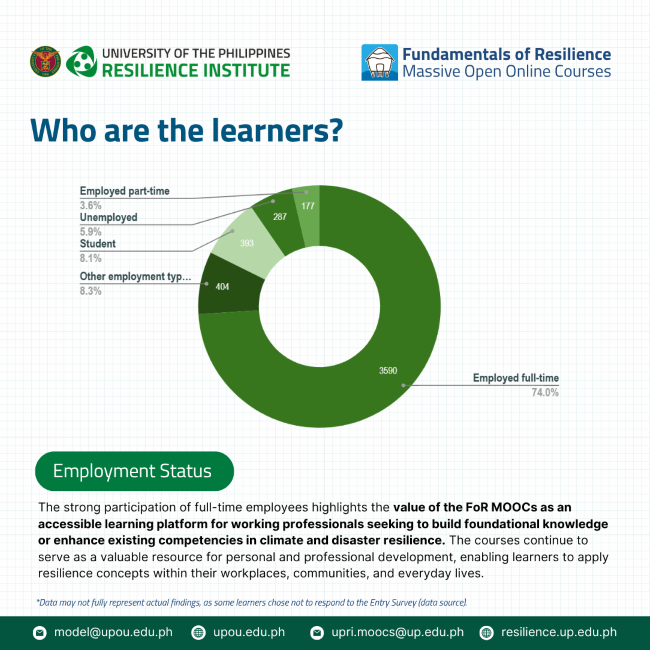
A majority of participants reported being employed full-time, with 3,560 learners accounting for approximately 74% of the overall sample population. Students, unemployed individuals, part-time employees, and those under other employment arrangements likewise participated in the courses. The findings reflect the flexibility of the FoR MOOCs in accommodating learners with diverse personal and professional commitments.
The strong participation of full-time employees highlights the value of the FoR MOOCs as an accessible learning platform for working professionals seeking to build foundational knowledge or enhance existing competencies in climate and disaster resilience. The courses continue to serve as a valuable resource for personal and professional development, enabling learners to apply resilience concepts within their workplaces, communities, and everyday lives.
h. Economic Background 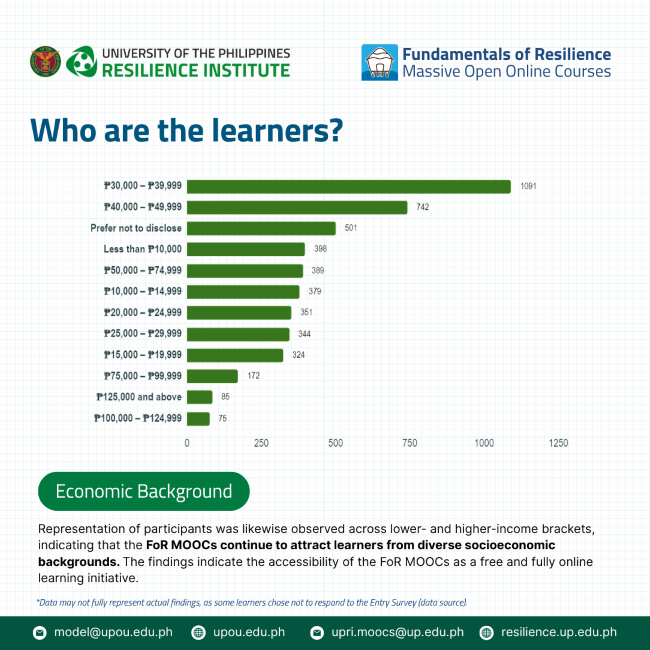
Participants came from a wide range of income groups, with the largest proportion reporting monthly incomes between ₱30,000 and ₱39,999. Representation was likewise observed across lower- and higher-income brackets, indicating that the FoR MOOCs continue to attract learners from diverse socioeconomic backgrounds.
The findings indicate the accessibility of the FoR MOOCs as a free and fully online learning initiative. This is particularly significant considering that disaster risk and resilience are shaped by a range of social and economic factors. As emphasized in the Sendai Framework for Disaster Risk Reduction 2015–2030, an inclusive and people-centered approach is essential to strengthening resilience across all sectors of society (United Nations, 2015). By making resilience education accessible to learners from different socioeconomic backgrounds, the FoR MOOCs contribute to broader efforts toward inclusive capacity-building and disaster risk reduction.
i. Participation of Key Government Stakeholders: DepEd and DSWD 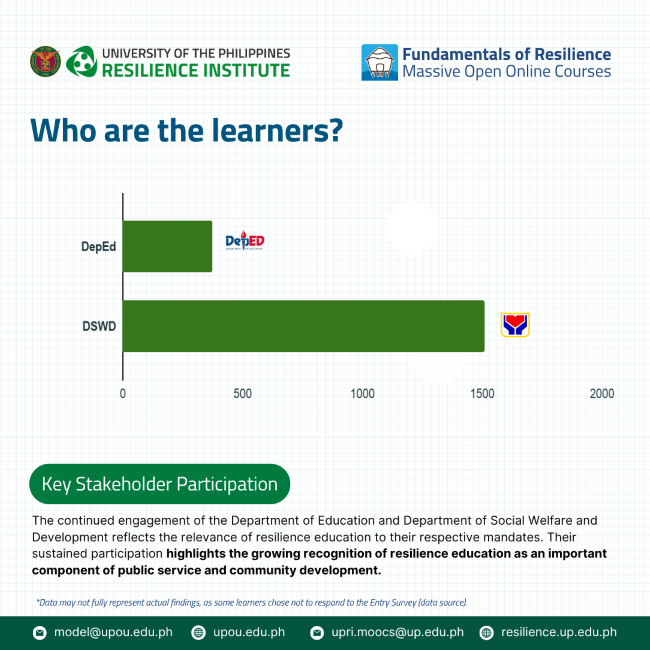
Participation from key institutional partners remained substantial during the latest run of MOOCs 3 and 4. A combined total of 1,887 learners came from the Department of Education (DepEd) and the Department of Social Welfare and Development (DSWD), including 375 participants from DepEd and 1,512 participants from DSWD.
The continued engagement of these national government agencies reflects the relevance of resilience education to their respective mandates. As the agency responsible for basic education, DepEd plays a vital role in promoting disaster preparedness and resilience within schools and learning communities. Meanwhile, DSWD’s mandate of social protection and community welfare places it at the forefront of supporting vulnerable populations and strengthening community resilience. Their sustained participation highlights the growing recognition of climate and disaster resilience as an important component of education, public service, and community development.
Ways Forward: From Record Completions to Greater Impact
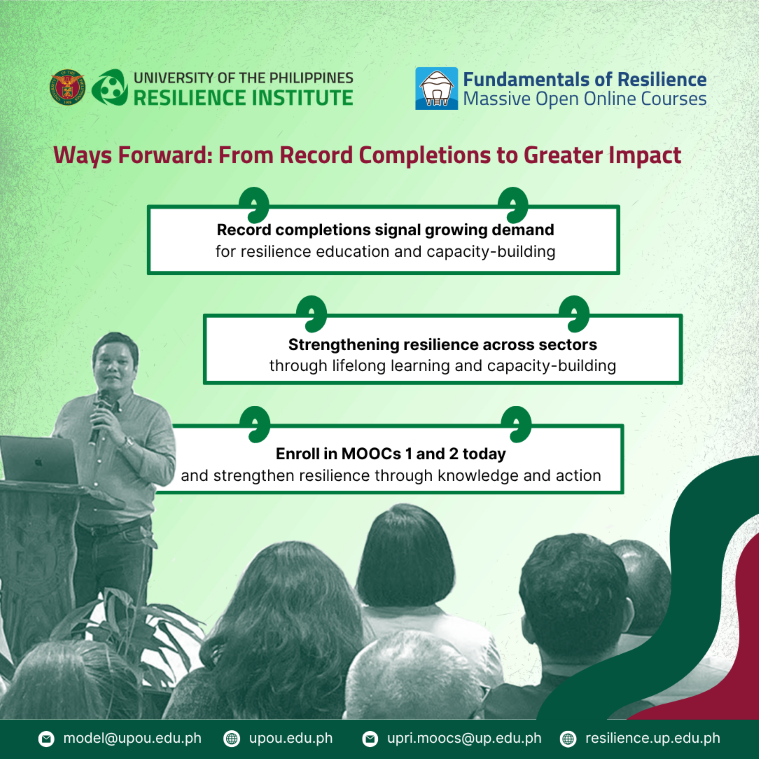
The successful completion of MOOCs 3 and 4 marks the conclusion of the first cycle of the 2026 Fundamentals of Resilience (FoR) MOOC Series and another milestone in the continuing efforts of the UP Resilience Institute (UPRI) and the UP Open University (UPOU) to expand access to resilience education across the Philippines and beyond.
The record number of completers achieved during this run reflects the growing recognition of resilience as an essential competency in an increasingly complex and disaster-prone world. The strong participation of learners from government, academe, the private sector, civil society, and local communities further highlights the value of resilience education in fostering preparedness, adaptation, and collective action across sectors. Through the FoR MOOCs, UPRI and UPOU remain committed to empowering individuals and institutions with the knowledge and skills needed to build safer, more adaptive, and more resilient communities.
Building on the momentum of the first cycle, the second 2026 run of MOOC 1: Basics of Resilience and MOOC 2: Hazard and Risk Assessment Fundamentals officially commenced on 15 June 2026 and will run until 10 July 2026 (Enrollment links: https://resilience.up.edu.ph/fundamentals-of-resilience/). Learners from all sectors are invited to join the growing FoR MOOCs community and continue strengthening resilience through knowledge and action.
Related Links:
Expanding Resilience Education: Learner Engagement in the 2026 Relaunch of FoR MOOCs 1 and 2. https://resilience.up.edu.ph/expanding-resilience-education-learner-engagement-in-the-2026-relaunch-of-for-moocs-1-and-2/
Learning Resilience Made Free, Inclusive, and Nationwide: Takeaways from the 2025 Relaunching of the Basics of Resilience MOOCs 3 and 4. https://resilience.up.edu.ph/learning-resilience-made-free-inclusive-and-nationwide-takeaways-from-the-2025-relaunching-of-the-basics-of-resilience-moocs-3-and-4/
Empowering Action Through Education: Basics of Resilience MOOCs Relaunched for NDRM 2025. https://resilience.up.edu.ph/empowering-action-through-education-basics-of-resilience-moocs-relaunched-for-ndrm-2025/
The Basics of Resilience MOOC expands its reach in early 2025! https://resilience.up.edu.ph/the-basics-of-resilience-mooc-expands-its-reach-in-early-2025/
Over 17,000 enrolled in UP’s online course on resilience. https://resilience.up.edu.ph/over-17000-enrolled-in-ups-online-course-on-resilience/
Relaunched of the Basics of Resilience: A continued program for accessible, inclusive, and multidisciplinary DRR and CCAM education. https://resilience.up.edu.ph/relaunched-of-the-basics-of-resilience-a-continued-program-for-accessible-inclusive-and-multidisciplinary-drr-and-ccam-education/
UP’s online course on resilience concludes with over 11,000 enrollees. https://resilience.up.edu.ph/ups-online-course-on-resilience-concludes-with-over-11000-enrollees/
UPRI, UPOU’s free course on Basics of Resilience kicks off with 2,100 enrollees. https://resilience.up.edu.ph/upri-upous-free-course-on-basics-of-resilience-kicks-off-with-2100-enrollees/