
Written by Alexa Samantha Hernandez and Dainty Clarice Rabang of the UP Resilience Institute (UP RI) Education Division, in collaboration with the UP RI Institution Building Division
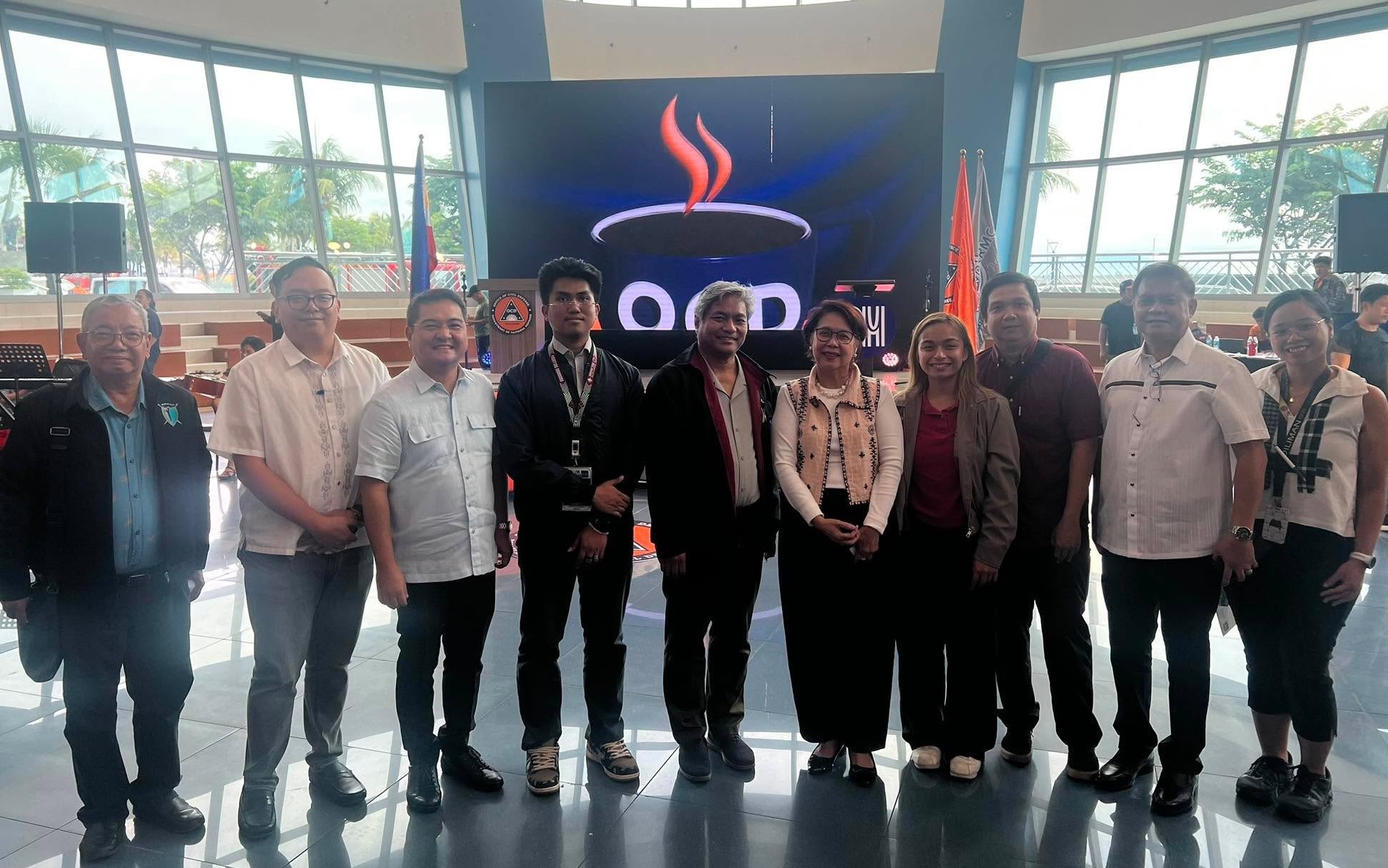
The UP Resilience Institute (UPRI) participated in the official launch of the 38th National Disaster Resilience Month (NDRM) on July 1, 2026, organized by the Office of Civil Defense (OCD) in partnership with ARISE Philippines and SM Prime Holdings.
The event brought together representatives from national government agencies (NGAs), local government units (LGUs), the private sector, civil society, and the academe, highlighting the importance of a whole-of-government and whole-of-society approach to disaster resilience. UPRI’s participation reflects the critical role of higher education institutions in contributing research, innovation, and technical expertise to support evidence-informed decision-making and strengthen the country’s disaster resilience agenda.
This year’s NDRM carries the theme “Naghahanda at Kumikilos Tungo sa Panatag na Pilipinas.” During the program, representatives from key government agencies presented initiatives under the country’s four thematic pillars of disaster risk reduction and management: prevention and mitigation, preparedness, response, and recovery and rehabilitation.
Department of Science and Technology (DOST) Assistant Secretary Rodolfo Calsado Jr. highlighted the role of science, technology, and innovation in supporting informed decision-making. Department of the Interior and Local Government (DILG) Assistant Secretary Lilian M. de Leon discussed efforts to strengthen resilient infrastructure and emergency response systems, while Department of Social Welfare and Development (DSWD) Assistant Secretary Diana Rose Cajipe reaffirmed the agency’s commitment to timely humanitarian assistance and early recovery interventions. Department of Economy, Planning, and Development (DepDev) Director Remedios Endencia emphasized coordinated and context-specific recovery and rehabilitation efforts aligned with local needs and national development goals.
Representatives from ARISE Philippines and the National Resilience Council likewise voiced out their support in sustained multi-stakeholder collaboration towards a proactive and resilient nation. Delivering the closing message, Department of National Defense Undersecretary Irineo C. Espino reminded participants that disaster resilience is a shared responsibility and called on all sectors to translate their commitment into sustained action.
As part of the program, the NDRRMC and its partner agencies also launched their planned activities throughout the month, such as Over Coffee Dialogues, the Disaster Run, Disaster Jamboree, and the Regional Rescuelympics to strengthen public awareness and preparedness nationwide.
UPRI joins this national observance not only as a participant but also as an active partner in advancing disaster resilience through research, education, and public engagement. As a member of the Philippine Preparedness Partnership (PhilPrep), UPRI continues to champion disaster risk reduction and management (DRRM) by fostering multisectoral collaboration, strengthening institutional capacities, and promoting resilience-building initiatives across the country. Learn more about UPRI’s role in PhilPrep and its contributions to advancing resilience through regional and international partnerships here: https://resilience.up.edu.ph/philprep-champions-multi-sector-collaboration-for-resilience-in-colombo-sri-lanka-with-upri-as-academic-pillar/.
PhilPrep is a quadripartite partnership composed of the Office of Civil Defense (OCD), the Center for Disaster Preparedness (CDP), the Philippine Disaster Resilience Foundation (PDRF), and the UP Resilience Institute (UPRI). Through this collaboration, UPRI reaffirms its commitment to a multi-stakeholder, whole-of-society approach to building a more disaster-resilient Philippines.


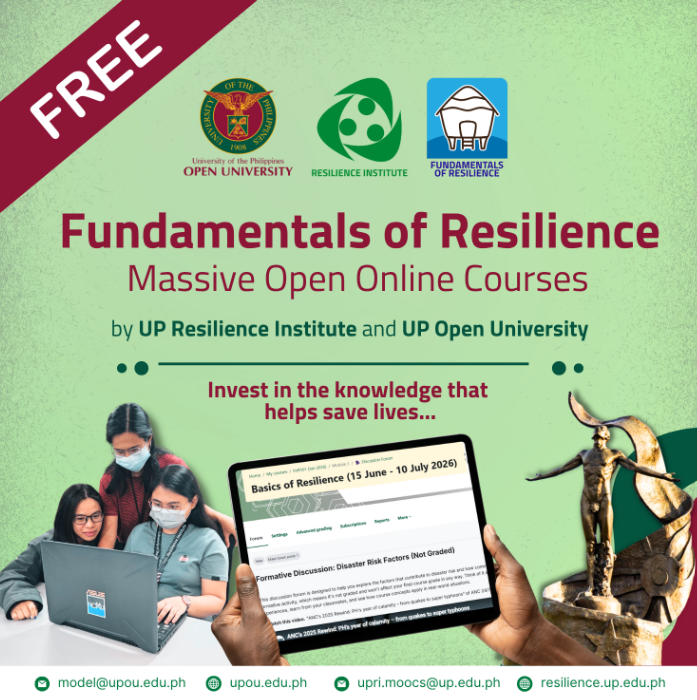
In support of this year’s National Disaster Resilience Month, the Institute continues to roll out a series of activities that promote resilience learning and capacity building, including the launch of its Massive Open Online Course (MOOC) on the Fundamentals of Resilience.
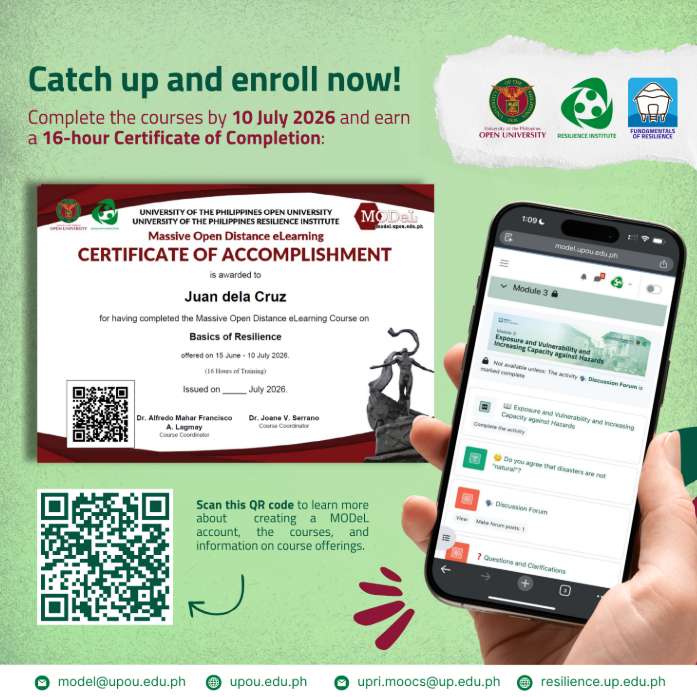
Interested participants may access and complete the Basics of Resilience and Hazard and Risk Assessment Fundamentals courses until July 10, 2026, at 11:59 PM. To learn more and enroll, click here: https://resilience.up.edu.ph/fundamentals-of-resilience-mooc-series-returns-in-2026-with-a-new-look-new-features-and-expanded-access/.
Through such initiatives, UPRI continues to contribute to the national goal of building resilient communities by translating scientific knowledge into practical learning opportunities and supporting evidence-informed governance, especially during National Disaster Resilience Month.