
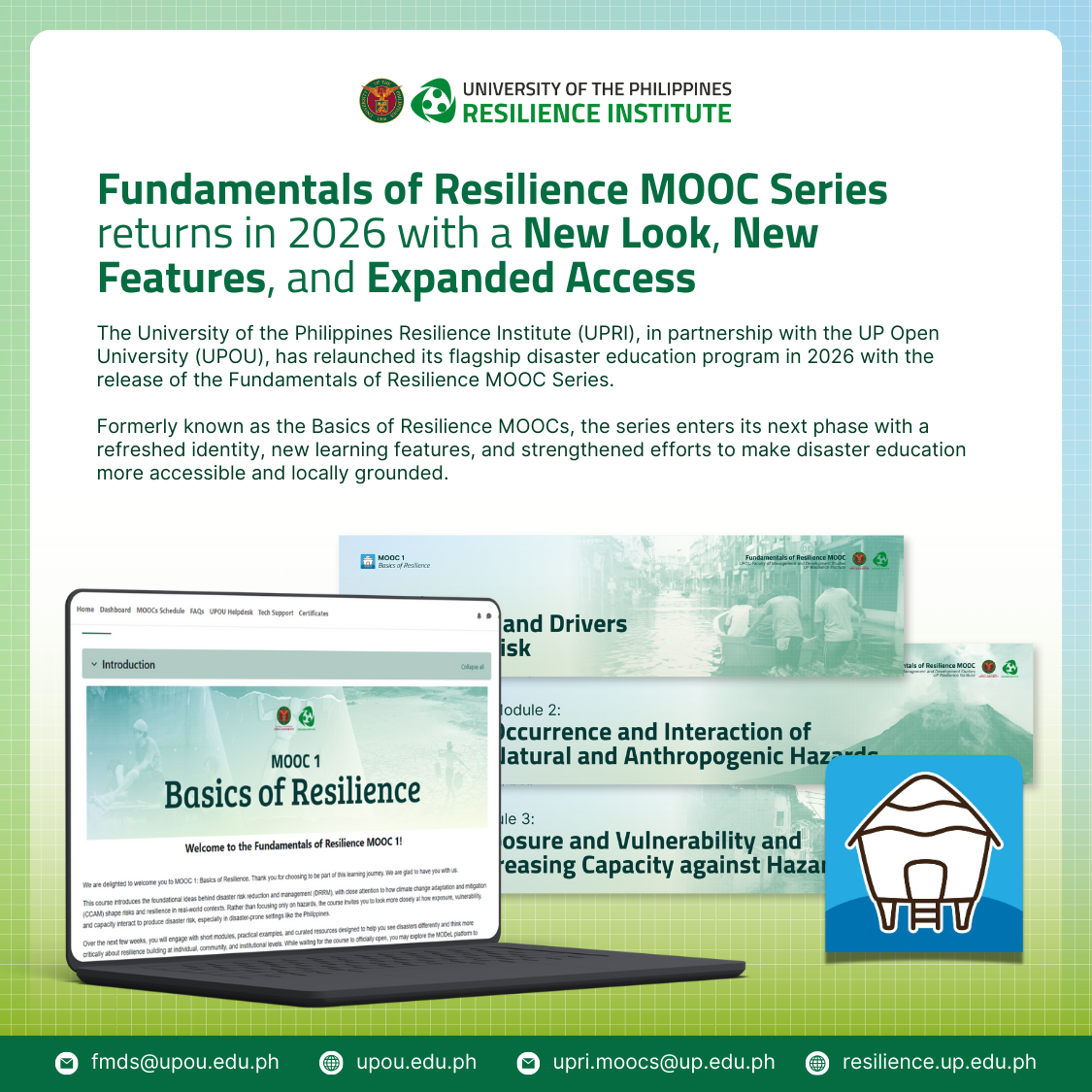
The University of the Philippines Resilience Institute (UPRI), in partnership with the UP Open University (UPOU), has relaunched its flagship disaster education program in 2026 with the release of the Fundamentals of Resilience MOOC Series. Formerly known as the Basics of Resilience MOOCs, the series enters its next phase with a refreshed identity, new learning features, and strengthened efforts to make disaster education more accessible and locally grounded.
The shift from Basics of Resilience to Fundamentals of Resilience reflects its evolving position as a foundational learning program within UPRI’s broader resilience education initiatives. The new name signals a deeper emphasis on core concepts and principles that underpin disaster risk reduction, climate change adaptation, and resilience building. This change also anticipates future developments that will further strengthen learning pathways in climate and disaster resilience. More details will be shared later this year, so keep an eye out.
Although the name has evolved, the program’s structure remains the same. The Fundamentals of Resilience MOOC Series continues to be composed of four standalone but interconnected courses that introduce learners to key concepts in disaster risk reduction, climate change adaptation, and resilience building.
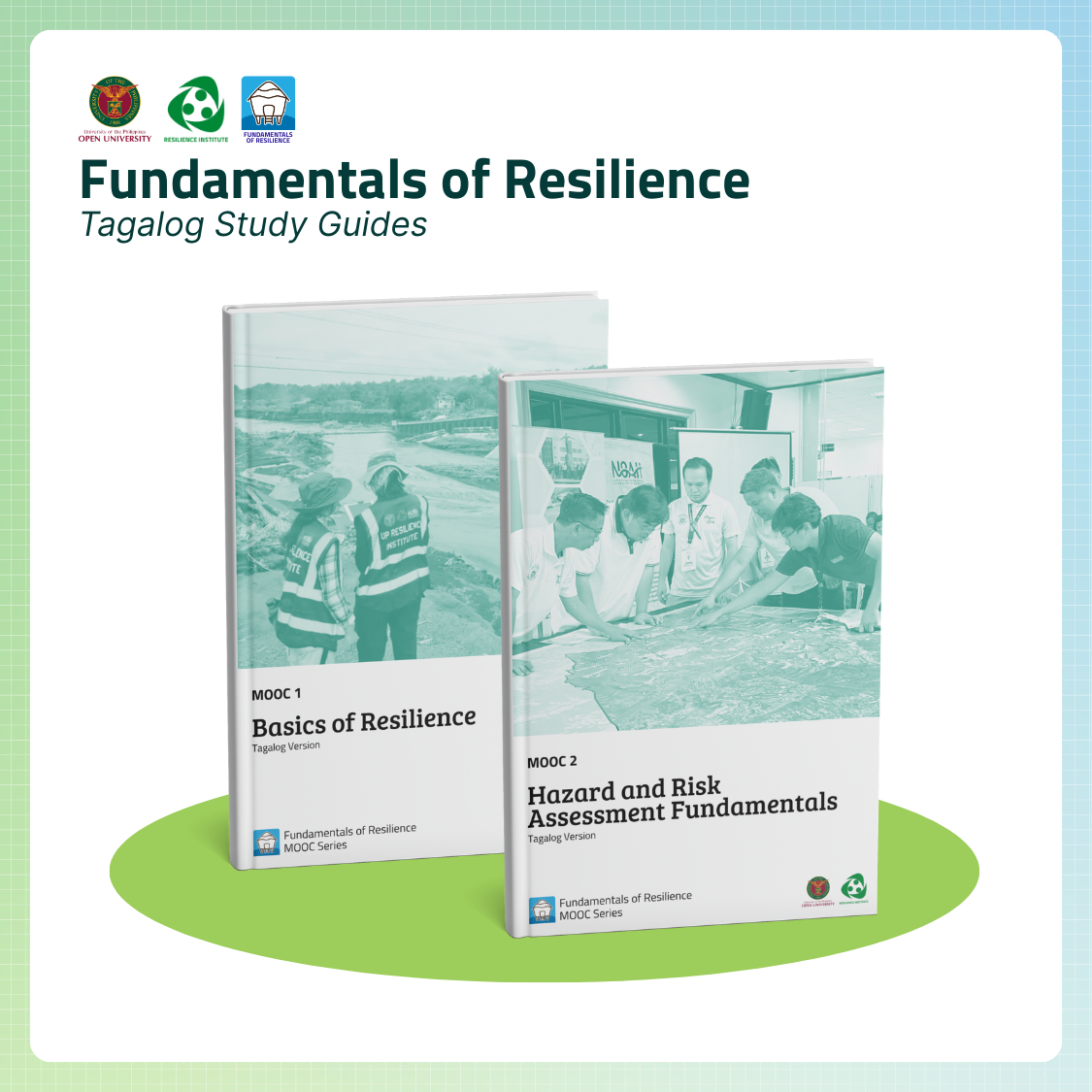
A major development this year is the release of Tagalog translations of the MOOCs in the form of downloadable study guides. These translated guides are part of UPRI’s broader effort to localize climate and disaster education and reach learners who may face language or connectivity barriers. Learners can use the study guides alongside the online course or as an offline learning resource. Translations into other Philippine languages are also planned in the future, reinforcing the UPRI’s commitment to inclusive and accessible learning.
For the first time since the series was launched in 2024, the Fundamentals of Resilience MOOC Series will also have an official logo. This new visual identity helps consolidate the series as a coherent learning program, strengthens its recognition across platforms, and reflects its growing role as a core public education initiative on climate and disaster resilience.
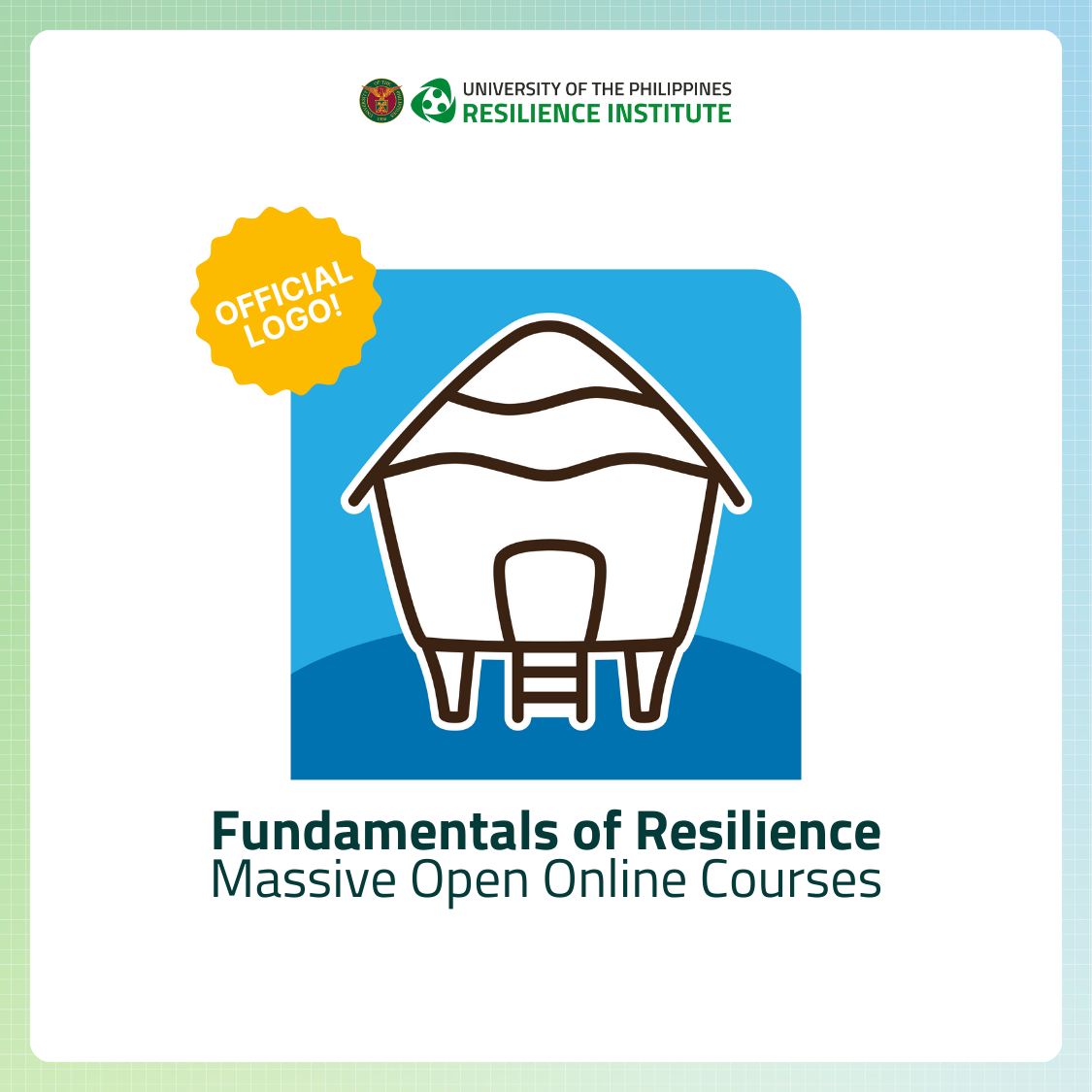
The official logo of the Fundamentals of Resilience MOOC Series features a bahay kubo, a traditional Filipino dwelling that embodies the core ideas of resilience, bayanihan (communal unity and cooperation), and sustainability. Designed to withstand local environmental conditions such as heat, flooding, and strong winds, the bahay kubo reflects vernacular knowledge developed through generations of lived experience with hazards. Its lightweight materials, elevated structure, and flexibility illustrate that resilience is not only about strength but also about responsiveness and the ability to adapt to changing conditions. As a familiar and culturally grounded symbol, the bahay kubo underscores the series’ emphasis on local content, collective effort, and foundational principles that support safety and well-being. In the same way that a house is built from interconnected parts, the four MOOCs form the building blocks of resilience, coming together to create a stronger and more holistic understanding of climate and disaster risk.
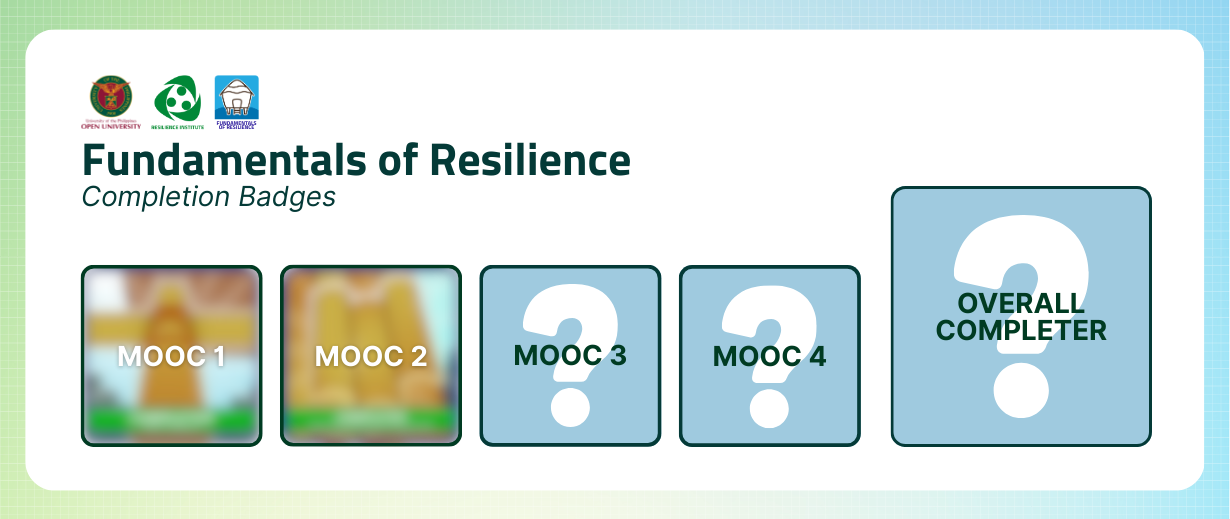
Learners completing the courses in 2026 can also look forward to the introduction of digital badges. Each MOOC will have its own badge, which will be awarded upon successful completion. Those who finish all four courses will unlock a special series-level badge, a final marker of completion that recognizes sustained engagement across the entire program. These digital badges allow learners to showcase their achievements across professional and personal platforms, including online portfolios and social networking sites.
For this release, only the digital badges for the ongoing MOOCs 1 and 2 are being unveiled. These first two badges offer a glimpse into the visual language of the series, with each design reflecting key ideas and learning themes from the course. As the remaining MOOCs are rolled out later in the year, their corresponding badges will be revealed as well.
Beyond individual learning, UPRI is also taking steps to foster a growing community of practice around resilience. A dedicated Facebook Community Group for Fundamentals of Resilience completers will be launched once the first pair of MOOCs concludes in February 2026. This space is envisioned as a platform where learners can continue conversations beyond the course, share experiences from their own contexts, exchange resources, and reflect on how resilience concepts are applied in practice. Past completers of the MOOCs will also be invited to join the group, helping build continuity across course runs and strengthening connections among learners from different batches, sectors, and regions.
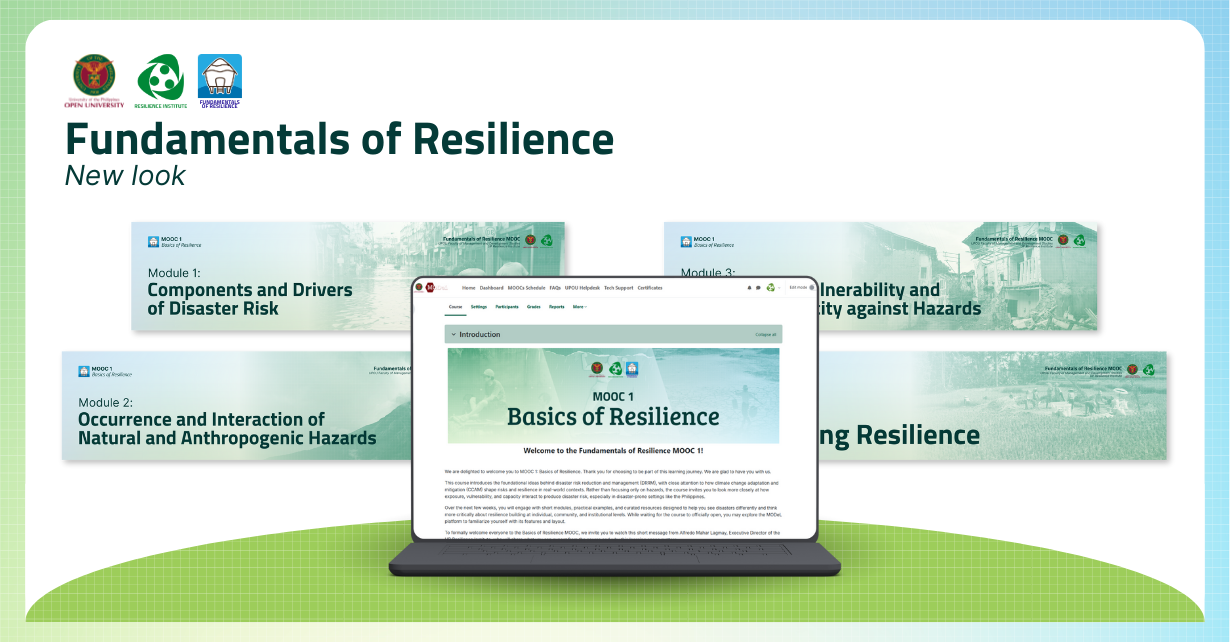
In line with these updates, both the study guides and the course site will feature a refreshed look that aligns with the new name and visual identity of the series. These design updates aim to improve readability and user experience, and will also be reflected in the MOOCs’ social media materials and announcements.
To further streamline learner support, UPRI has also introduced centralized communication for the MOOC series. Participants may now send course-related inquiries to the dedicated email address: upri.moocs@up.edu.ph.
The Fundamentals of Resilience MOOC Series will be offered multiple times throughout 2026 to accommodate different learner schedules:
- January to February 2026 – MOOCs 1 and 2
- April to May 2026 – MOOCs 3 and 4
- June to July 2026 – MOOCs 1 and 2
- October to November 2026 – MOOCs 3 and 4
Final opening dates for each run are subject to approval and will be announced through the UP Resilience Institute Facebook Page and the UPOU MODeL Facebook Page.
The Fundamentals of Resilience MOOC Series remains free and open to the public, continuing UPRI and UPOU’s shared commitment to democratizing access to disaster and climate resilience education. Learners who complete the courses will receive certificates, alongside the newly introduced digital badges.
As climate and disaster risks continue to shape everyday life, the 2026 release of the Fundamentals of Resilience MOOC Series reflects a renewed commitment to learning that is accessible, locally relevant, and responsive to the needs of diverse communities.