
By Isabel Andaya, UP RI Education Division
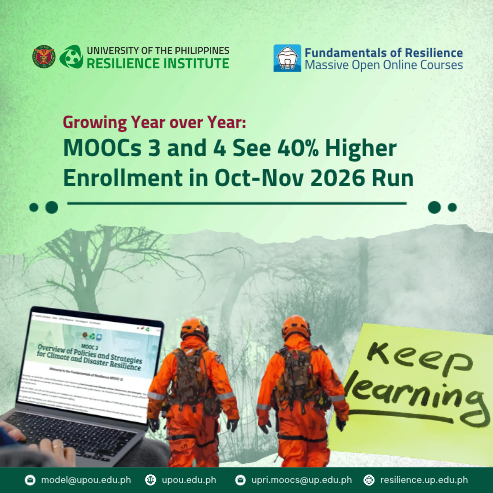
The Fundamentals of Resilience (FoR) Massive Open Online Courses (MOOCs) ended 2026 on a high note. From 13 October to 10 November, learners from across the country and abroad took on MOOC 3: Overview of Policies and Strategies for Climate and Disaster Resilience and MOOC 4: Resilience Strategies Across the Four Pillars, offered by the UP Resilience Institute (UPRI) in partnership with the UP Open University (UPOU).
This offering drew 5,334 enrollments, about 40% more than the October 2025 run of MOOCs 3 and 4 . Completion held steady, with 969 learners finishing MOOC 3 (34.9%), close to last year’s 35.4%, and 815 learners finishing MOOC 4, raising its completion rate from 28.4% to 31.9%.
Together, the two courses take learners from policy to practice. MOOC 3 walks them through the laws, plans, and international frameworks that guide how climate and disaster risk is managed. Building on this, MOOC 4 looks at what resilience means in practice at every stage of a disaster, from prevention and mitigation to preparedness, response, and recovery and rehabilitation. These courses showcase how sound policies and everyday action work together to keep communities safe. Through them, we remain committed to making resilience education free, accessible, and inclusive for Filipinos wherever they are.
ABOUT OUR LEARNERS
All figures in this section are based on 1,327 Entry Survey responses from learners of legal age who consented to take part in the study. Learners who took both courses may have answered once for each. The data may not fully represent all learners, as some chose not to respond to the Entry Survey.
Geographic distribution
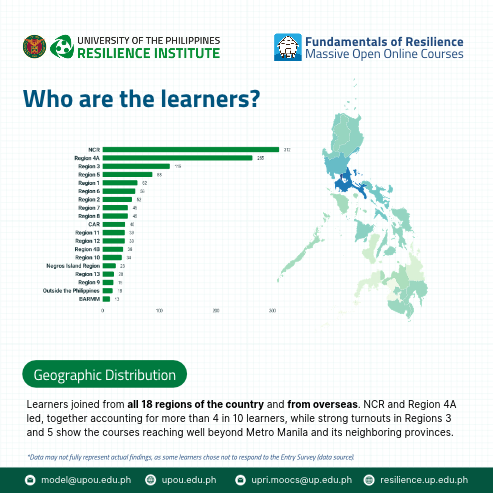
Our learners joined from all 18 regions of the country and from overseas. The National Capital Region (312, 23.5%) and CALABARZON (265, 20.0%) led, together accounting for more than four in ten learners, while strong turnouts in Central Luzon (119, 9.0%) and Bicol (88, 6.6%) showed the courses reaching well beyond Metro Manila and its neighbouring provinces. We were also glad to welcome learners from far-flung provinces such as Batanes, Apayao, Siquijor, Lanao del Sur, Basilan, and Tawi-Tawi, along with 18 learners from outside the Philippines.
Gender identity
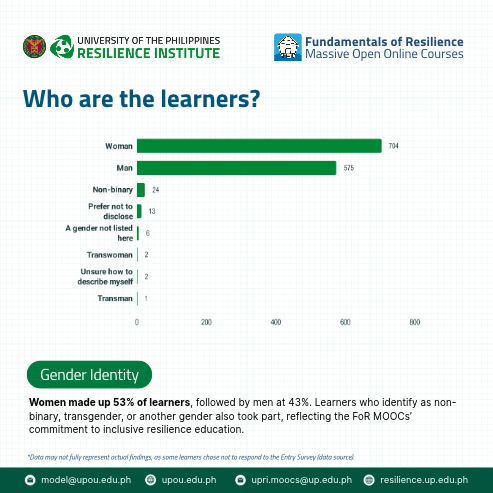
Women made up the majority of our learners (704, 53.1%), followed by men (575, 43.3%). We were also joined by learners who identify as non-binary, transgender, or another gender, and by those who preferred not to say, making up 3.6% of responses. Their participation reflected our commitment to keeping the FoR MOOCs a welcoming space for everyone.
Age group
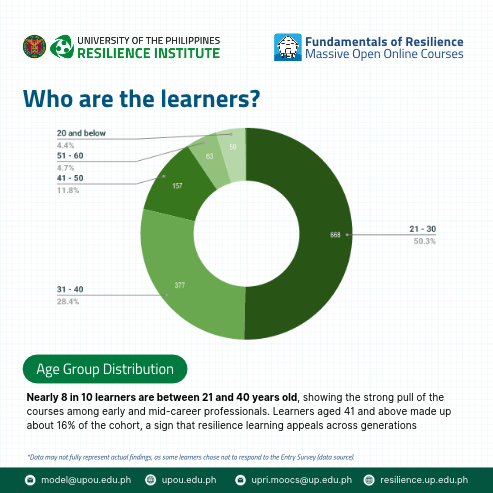
Nearly eight in ten learners were between 21 and 40 years old. Learners aged 21 to 30 alone made up half of the cohort (668, 50.3%), followed by those aged 31 to 40 (377, 28.4%), showing the strong pull of the courses among early- and mid-career professionals. Learners aged 41 and above made up about 17% of the cohort, a sign that resilience learning appealed across generations.
Work affiliation
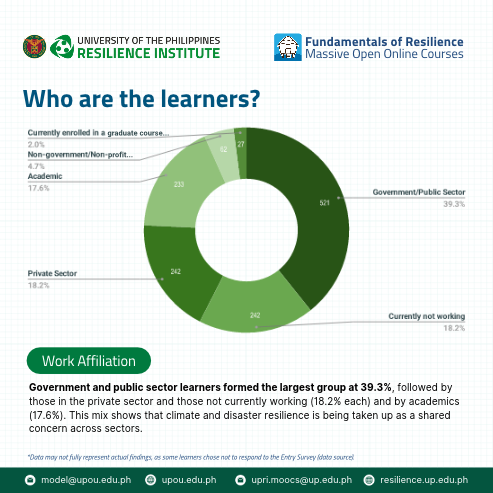
Government and public sector learners formed the largest group at 39.3% (521), followed by those in the private sector and those not currently working (18.2% each) and by academics (17.6%). Learners from non-government and civil society organizations (4.7%) and those enrolled in graduate studies (2.0%) also joined. Compared with last October, when government learners made up just over half of respondents (51.6%), this year’s cohort was more evenly spread, showing that climate and disaster resilience was being taken up as a shared concern across sectors.
Professional experience
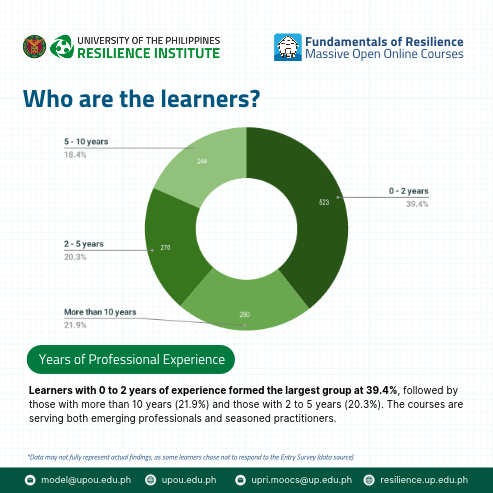
Learners with 0 to 2 years of experience formed the largest group at 39.4% (523), followed by those with more than 10 years (21.9%), those with 2 to 5 years (20.3%), and those with 5 to 10 years (18.4%). The courses served both emerging professionals who were building their foundation in resilience and seasoned practitioners looking to refresh what they knew.
Employment status
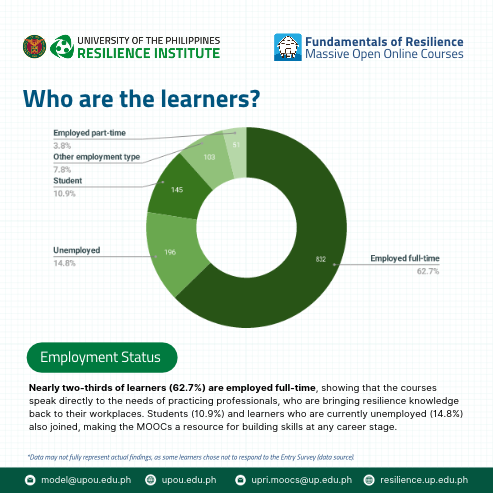
More than six in ten learners (62.7%) were employed full-time, showing that the courses spoke directly to the needs of practicing professionals who could bring resilience knowledge back to their workplaces. They were joined by students (10.9%) and learners who were unemployed at the time (14.8%), along with part-time workers and those in other work arrangements, making the MOOCs a resource for building skills at any career stage.
Educational attainment
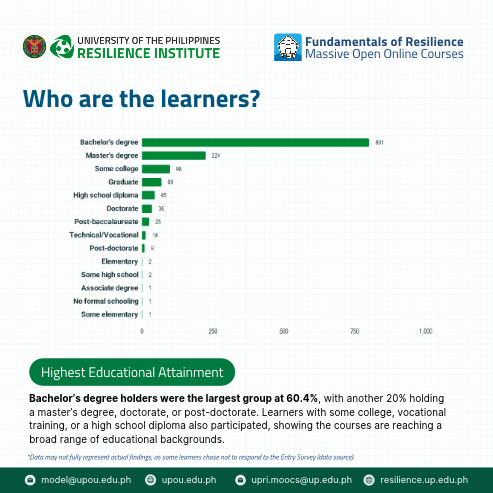
Bachelor’s degree holders were the largest group, making up about six in ten learners (801, 60.4%) , up from 56.6% last October, with another 20% holding a master’s degree, doctorate, or post-doctorate. Learners with some college, vocational training, or a high school diploma also participated, showing that the courses were reaching a broad range of educational backgrounds.
Economic background
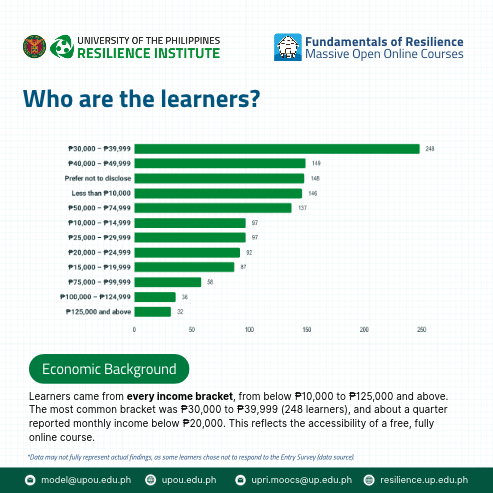
Our learners came from every income bracket, from below ₱10,000 to ₱125,000 and above in monthly household income. The most common bracket was ₱30,000 to ₱39,999 (248 learners, 18.7%), and about a quarter reported a monthly household income below ₱20,000, including 146 learners (11.0%) earning less than ₱10,000. This reflected the accessibility of a free, fully online course, which spared learners the cost of tuition and travel that often comes with training.
Key stakeholders: Continued participation from DepEd and DSWD
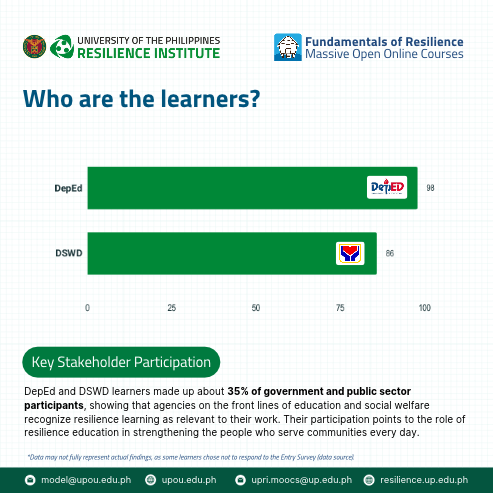
Since formally supporting the FoR MOOCs in early 2026, the Department of Education (DepEd) and the Department of Social Welfare and Development (DSWD) have been among our most important partners in resilience education. That partnership continued this run, with 98 learners from DepEd and 86 from DSWD, together making up about 35% of government and public sector participants. Their involvement showed that agencies on the front lines of education and social welfare recognized resilience learning as relevant to their work, and we are grateful for their continued support in strengthening the people who serve communities every day.
FROM OUR LEARNERS
Learners gave the courses an overall rating of 4.77 out of 5 (“Strongly Agree”), based on 754 Exit Survey responses. Organization and structure received the highest rating (4.81), followed closely by platform accessibility, meeting learners’ expectations, and interactive elements (4.80 each). Nearly all respondents (99.9%) said they would recommend the courses to others.
These encouraging results reflected what the FoR MOOCs were designed to be–easy to access from anywhere, self-paced to fit into learners’ daily lives, and grounded in Filipino contexts.
Many learners also shared how they planned to put their learning into practice. Among them were a school DRRM coordinator from Cavite and an administrative officer from Manila:
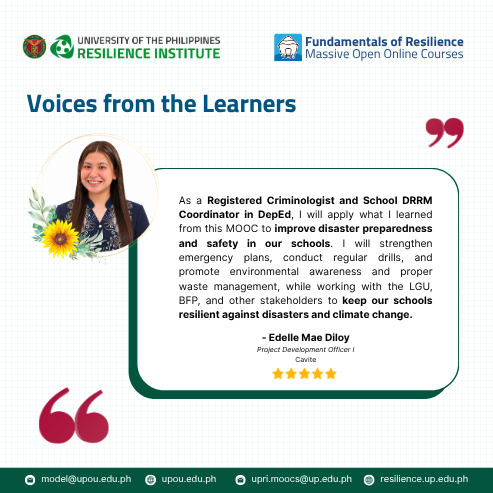
“As a Registered Criminologist and School DRRM Coordinator in DepEd, I will apply what I learned from this MOOC to improve disaster preparedness and safety in our schools. I will strengthen emergency plans, conduct regular drills, and promote environmental awareness and proper waste management, while working with the LGU, BFP, and other stakeholders to keep our schools resilient against disasters and climate change.”
— Edelle Mae Diloy, Project Development Officer I, Cavite
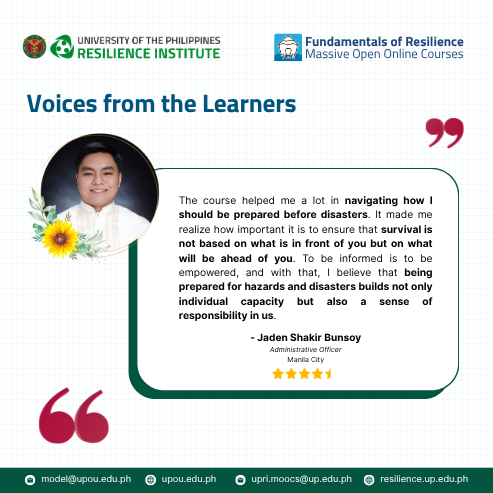
“The course helped me a lot in navigating how I should be prepared before disasters. It made me realize how important it is to ensure that survival is not based on what is in front of you but on what will be ahead of you. To be informed is to be empowered, and with that, I believe that being prepared for hazards and disasters builds not only individual capacity but also a sense of responsibility in us.”
— Jaden Shakir Bunsoy, Administrative Officer, Manila City
CONTINUING RESILIENCE EDUCATION IN 2027
As 2026 comes to a close, we thank every learner who signed up, worked through the modules, and saw the courses through, as well as the partner agencies and colleagues who helped spread the word. What learners take from these courses does not stay in the course–it goes back to the schools, offices, communities, and homes where resilience matters most.
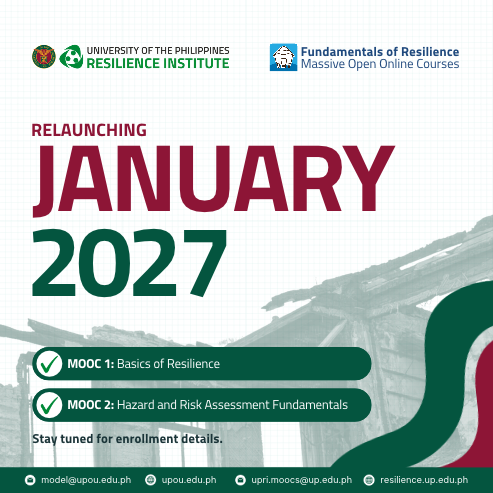
Haven’t tried the FoR MOOCs yet? Your next chance is just around the corner. MOOC 1: Basics of Resilience and MOOC 2: Hazard and Risk Assessment Fundamentals open again in January 2027. Keep an eye on UPRI’s official social media pages for the enrollment announcement.
Related Links:
- Sustaining Momentum in Resilience Education Through the Fundamentals of Resilience Massive Open Online Courses
- A Milestone in Resilience Education: MOOCs 3 and 4 Record Highest Number of Completers to Date
- Expanding Resilience Education: Learner Engagement in the 2026 Relaunch of FoR MOOCs 1 and 2
- Learning Resilience Made Free, Inclusive, and Nationwide: Takeaways from the 2025 Relaunching of the Basics of Resilience MOOCs 3 and 4