
As August approaches, Resilience Live enters its third year of creating a space for disaster risk reduction and climate change adaptation (DRR-CCA) knowledge sharing among diverse stakeholders. Throughout its journey, the initiative has continued to evolve, with different members of the UP NOAH Center Planning Component carrying forward its vision across successive organizing teams. Now led by the producing team of FJ Calvario and Stephany Joy Ayo, Resilience Live continues to build on the foundations established by those who came before while bringing fresh perspectives and renewed energy to the platform. Before the production of the third anniversary episode, the team looks back on the show’s evolution and impact on its viewers and on the team members themselves.
Creating Meaning in the Process
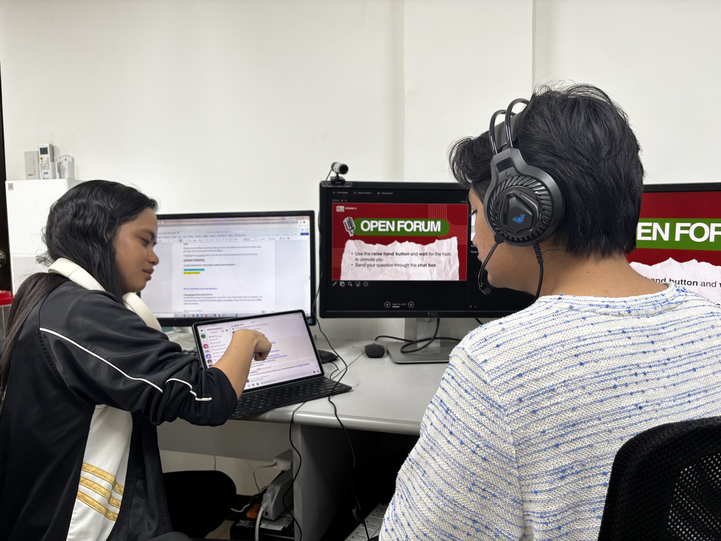
Every project has a why. For the team behind Resilience Live, meaning is found in moments of collaboration with different people and creating a space where conversations of resilience become accessible, relevant, and engaging for different audiences – even internationally. Their reason why is also, ironically, answered by the audience’s questions after the webinar, reflecting the relevance of the conversation the team was able to create. For the team, it is a sign that they successfully selected a speaker who resonated with the audience and sparked meaningful dialogue.
This shared sense of purpose is reflected in the experiences of individual team members. For. Rysch Nae Subijano, who previously served as the host for Episode 18 and 19, described the most meaningful aspect of the webinar was the collaboration with colleagues, speakers, and partner organizations to create “a space where resilience conversations become accessible, relevant, and engaging.”
The team’s sense of purpose is also reflected in the audience’s engagement. For. Janiella Sandoval, formerly the series producer from Episode 11 to 19, points out that the question-and-answer portion of each webinar has consistently been the most rewarding moment. “For us, it is a sign that we successfully selected a speaker who resonated with the audience and sparked meaningful dialogue”, For. Sandoval opines.
As part of the team that launched Resilience Live, April Dawn Tegelan, the series producer from Episode 1 to 11, reflected on the project’s beginnings and the challenge of starting from scratch. She recalled how starting an online knowledge-sharing platform differed from the institute’s usual activities, requiring the team to navigate new dynamics, logistics, and audiences. For her, the experience became a meaningful opportunity to adapt, learn, and further develop her craft.
Resilience Thrives Behind the Scenes
No project is without its challenges. But for the team behind Resilience Live, resilience thrives within these experiences, strengthening teamwork and building collective growth, and cultivating dynamic systems of care and support that will withstand any storm. The team reflected how there are a lot of behind-the-scenes of work, unseen by participants, that results in responding to unexpected challenges.
One key challenge for For. Subijano was translating complex and technical resilience topics into accessible and engaging discussions. She reveals, “We worked on making the discussions more relatable and less technical, so that even those who may not have a technical background could connect with the message.”
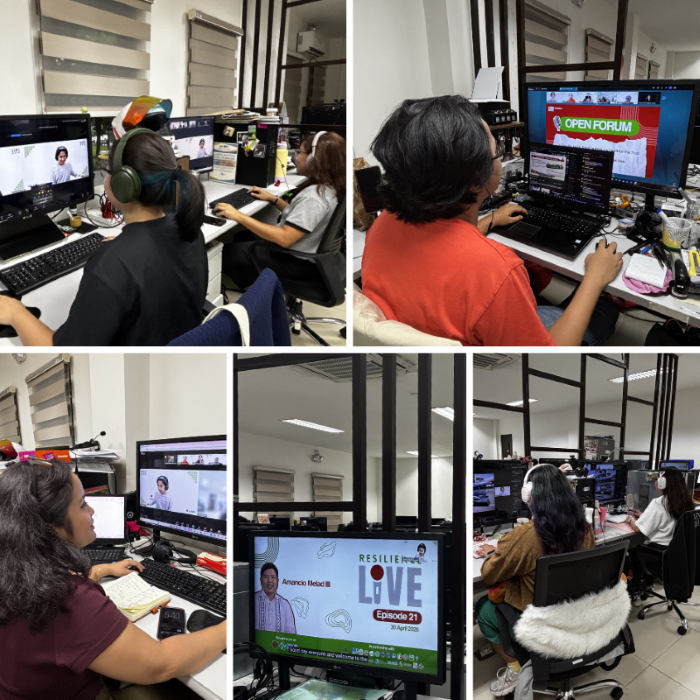
Meanwhile, For. Sandoval notes that there is a major challenge that happens in almost every episode. She praised how every team member has shown readiness to step in and support one another whenever needed. Over the years, each member constantly tries new roles for every episode, from coordinating with speakers, partners, and participants to dealing with last-minute changes and unexpected technical difficulties. No matter the challenge, the team always found a way to adapt and work together.
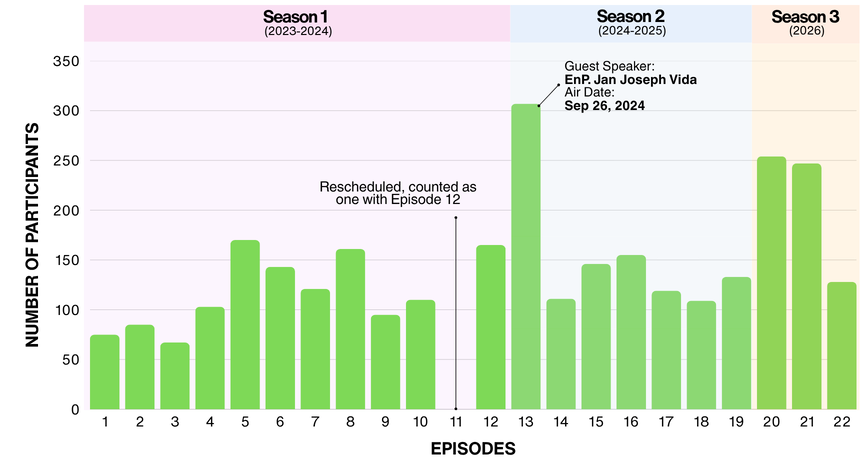
Originally conceptualized during the pandemic as a more general webinar series focused on uplifting stories, Resilience Live gradually evolved into its current format through countless brainstorming sessions and changes in the team’s composition. Team members expressed pride in how the webinar reached different audiences from different parts of the world. “Kasi when we started, we started peaking at around 60 audience [members] lang. Tapos nag-plateau ‘yun for a few months. And then, hanggang sa tumaas siya ng 100 plus, hanggang tumaas siya ng [300 audience members]. ” Tegelan shares. Overall, the team viewed the program’s journey as a testament to adaptability collaboration and a shared commitment to promoting resilience.
Reflections Captured through Memorable Quotes
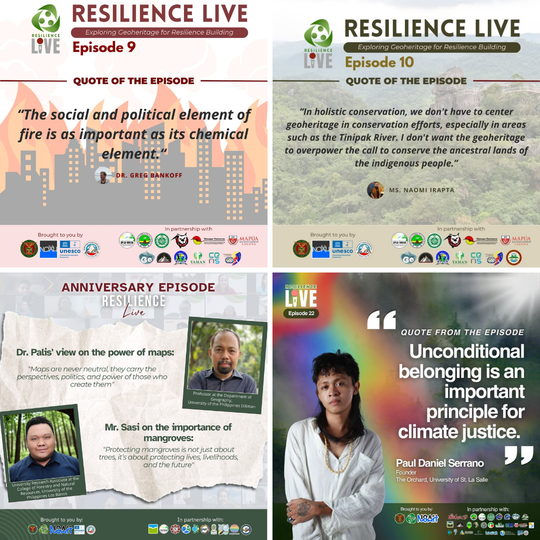
Throughout the planning process and the webinar, several messages resonated deeply with the team. One quote that stayed with For. Subijano came from the 2nd Anniversary episode. “Anyone can map their own stories,” said cultural geographer Dr. Joseph Palis. For. Subijano sees the statement highlighting the power of making invisible stories visible and creating space for experiences that often go unheard. She pondered the reality of multiple rural communities being exposed to climate risks, without having the same access to resilience education and resources as others. She reflects, “[Dr. Palis] reminded me how important it is to bring these conversations closer to communities and recognize that their experiences and knowledge are also valuable in building resilience.”
Meanwhile, For. Sandoval’s favorite quote is from Episode 13. “Mapping plays an important role to guide us and lead us to where we are going.” Spoken by episode guest For. EnP. Jan Joseph Dida, this quote highlighted that maps are more than just tools for visualization. In the context of resilience and sustainable development, mapping allows people to better understand risks, opportunities, and the pathways toward more informed and effective actions.
For Tegelan, the quote that resonated most with her came from the second episode, featuring Dr. Alfredo Mahar Lagmay, Executive Director of the UP Resilience Institute NOAH Center. Dr. Lagmay emphasized that “CCA-DRR has to be approached through a systems-based approach.” For Tegelan, this highlights how the impacts of hazards cut across multiple sectors and cannot be effectively addressed from a single perspective. Instead, climate change adaptation and disaster risk reduction require an integrated, systems-based approach that recognizes the interconnected nature of risks, vulnerabilities, and responses. She also remembered the fifth episode, featuring Dr. Aaron Opdyke. After the episode aired, the team visited Dr. Opdyke’s study sites, where they saw the results of the study being shared with local stakeholders and community members actively participating in discussions. Praising the community engagement, Tegelan reminisced, “So [the community members] were asking critical questions, which means na na-understand nila yung basic concepts ng project. Ibig sabihin, may ginawang tama yung project kasi na-reach niya talaga yung target audience niya, which is the community”. For her, the experience highlighted the value of participatory research in fostering meaningful community understanding and involvement.
Rethinking Resilience
The team reflected deeply on their responses, realizing that several stories had stayed with them long after the webinar series. Their reflections reinforced that resilience is about adapting, learning, and improving. Both For. Sandoval and For. Subijano emphasized that there are indeed misconceptions regarding resilience. It is more than simply “bouncing back” after a disaster. For the former, resilience meant “building systems and communities that are better prepared for future challenges.” Meanwhile, For. Subijano described building resilience as “changing the way we do things to create stronger and more sustainable systems.” Furthermore, for Tegelan, one of the most significant takeaways was the concept of climate justice. She reflected that the Philippines is indeed one of the most vulnerable countries to climate risks, believing it is the country’s responsibility to focus on adaptation and mitigation. “Pero in reality, there is a wider concept here. Tayo yung apektado, pero hindi tayo yung main contributor. So, gusto ko siyang i-challenge,” Tegelan notes the irony.
Beyond Resilience
On the question of the webinar series inspiring real-life actions, For. Subijano hopes that it encourages people to reflect on their role in contributing to resilience. She highlighted that small actions could create meaningful change. As she puts it, “Resilience starts with each of us, but it is something we build together.” For her, resilience is not solely the responsibility of institutions or experts but a continuous process of learning, adapting, and collaborating across communities and sectors.
For. Sandoval echoed this sentiment, expressing hope that the conversation brought upon each episode inspires people to stay curious and continue learning about resilience. She stressed that building resilience does not always require large-scale initiatives; it can begin with understanding local risks, engaging in conversations, and applying new knowledge in everyday decisions. In her view, “Every informed decision, no matter how small, contributes to a more resilient future.” As challenges become increasingly complex, she highlighted the importance of collaboration, continuous learning, and shared responsibility in strengthening resilience.
Meanwhile, Tegelan hoped that the participants learned and enjoyed every episode. She mentioned that it does not have to be specific learning but for people to gain an understanding of the variety of topics that the webinars have explored. She also emphasized that resilience and DRR-CCA are actually transdisciplinary. Understanding resilience, she noted, requires exploring multiple perspectives rather than remaining within a single discipline. Ultimately, she hopes participants will “absorb the culture of resilience on their own and practice it.”
Unboxing Resilience

“Out of the box” were the four words that Tegelan used to describe Resilience Live during its conception, alluding to how different Resilience Live is to the team’s usual activities. But in a span of three years, the project has grown to be a collaborative, meaningful, eye-opening platform that has contributed to the team’s evolving understanding of resilience. Together with their everyday work experiences, the webinar has helped them deepen their appreciation of resilience being dynamic and extending beyond the webinar.
Before the webinar, For. Subijano believed that climate resilience is simply preparing and recovering from climate impacts. However, the webinar contributed to her realization that resilience is also about learning, collaboration, innovation and creating systems that allow people and communities to thrive despite the uncertainty.
Meanwhile, for For. Sandoval, climate resilience had often been understood as the ability to withstand and recover from climate-related hazards such as typhoons, floods, and droughts. Through the preparations for the webinar series, her perspective evolved in much the same way as Subijano’s. She came to see resilience not only as recovery, but also as the capacity to anticipate risks, adapt to changing conditions, and transform systems so that communities can thrive despite uncertainty. For her, resilience is as much about people, governance, and decision-making as it is about infrastructure and technology.
For Tegelan, her understanding of resilience began to take shape when she joined the team. Before entering the field, her previous work had little to do with climate resilience. “At that time, yung concept ng climate change, aside from what you learn[ed] in high school and university, it seemed nebulous”, she recalls. “Alam ko na it affects us adversely, pero hindi ko alam yung complex concepts, yung impacts and how to address it or mitigate.” Tegelan working in the field gradually changed that perspective. She understood why these disasters occur, how societies can adapt and mitigate their impacts, and what role different sectors can play in addressing them.
Interview by Mikaella Hipolito, UP NOAH Planning Intern
Content by FJ Calvario, Stephany Joy Ayo, and Mikaella Hipolito